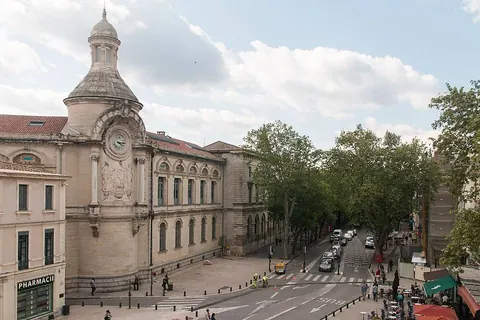

You are now on the grand boulevards that encircle the Écusson, the old heart of Nîmes. If you follow them, you walk around the old medieval town: these boulevards follow the line of the ramparts, demolished in the eighteenth century. In the nineteenth century, they became the town’s showcase. On Boulevard Victor-Hugo, which links the Maison Carrée to the Arena, stand the Church of Saint-Paul, built from 1835 to 1849 by Charles-Auguste Questel with a bell tower 62 metres high, and the Lycée Alphonse-Daudet, heir to the university founded by Francis the First in 1539. To the north, Boulevard Gambetta bears the name of Léon Gambetta, head of government in 1881. It holds a darker memory: during the Occupation, from November 1942, the Gestapo set up at 13 Boulevard Gambetta. On the corner with Boulevard Amiral-Courbet, look at the two neo-Gothic spires of the Church of Saint-Baudile. Today, the traffic runs anticlockwise. Walk on, and at each corner spot the transition between the old town and the nineteenth century town.
History
The grand boulevards around the Écusson were created by the demolition of the old ramparts in the 18th century; they follow the line of the medieval walls. From the early 19th century, major developments reinforced the monumental character of the town: the Church of Saint-Paul, the lycée and its clock tower, the Couronne, Bouquerie and Antonin squares, middle-class apartment buildings and mansions.
Art and architecture
The Church of Saint-Paul, in the neo-Romanesque style, was built from 1835 to 1849 to plans by Charles-Auguste Questel. Its bell tower rises to 62 metres. It contains wall paintings by Hippolyte Flandrin and an organ built in 1848 by Aristide Cavaillé-Coll. Further north, the neo-Gothic Church of Saint-Baudile (1867 to 1877) marks with its two spires the junction of Boulevard Amiral-Courbet and Boulevard Gambetta.
Anecdotes
The Lycée Alphonse-Daudet, on Boulevard Victor-Hugo, sees itself as heir to the University of Nîmes founded by Francis I in 1539, which became a Jesuit college in 1670. It took the name of Alphonse Daudet in 1966. Boulevard Gambetta recalls a dark chapter: the Gestapo moved into number 13 during the Occupation, which began in Nîmes in November 1942.
What to look for
On Boulevard Victor-Hugo, observe the bell tower of Saint-Paul and the archway of the Lycée Daudet, topped by the town’s emblem: a miniature of the Arena crowned by the Maison Carrée. On Boulevard Gambetta, look east for the spires of Saint-Baudile.
Practical
The boulevards are open access. Going clockwise from the north-west corner, the Écusson is bordered by the Square Antonin, the Square de la Bouquerie, Boulevard Gambetta, Boulevard Amiral-Courbet, the Square de la Couronne, the esplanade, Boulevard des Arènes, Boulevard Victor-Hugo and Boulevard Alphonse-Daudet. Cars use two lanes running anticlockwise.
Nearby
Boulevard Victor-Hugo links the Maison Carrée to the Arena: two major monuments at either end. Boulevard Gambetta leads towards the Square de la Bouquerie and the Square Antonin, with a view down the Canal de la Fontaine.

On site, look for: On Boulevard Victor-Hugo, look up at the bell tower of the Church of Saint-Paul and estimate its height.
Test yourself
What line do the boulevards of the Écusson follow?
- A railway line
- An old canal
- The medieval ramparts (answer)
Which secondary school stands on Boulevard Victor-Hugo?
- Alphonse-Daudet (answer)
- Henri-IV
- Louis-le-Grand
What moved into 13 Boulevard Gambetta in 1942?
- A theatre
- The Gestapo (answer)
- The town hall
Sources
- Wikipedia: Écusson (Nîmes)
- Wikipedia: History of Nîmes
- Wikipedia: Church of Saint-Paul, Nîmes
- Wikipedia: Lycée Alphonse-Daudet
- Wikipedia: Léon Gambetta
Information checked on 6 October 2026.