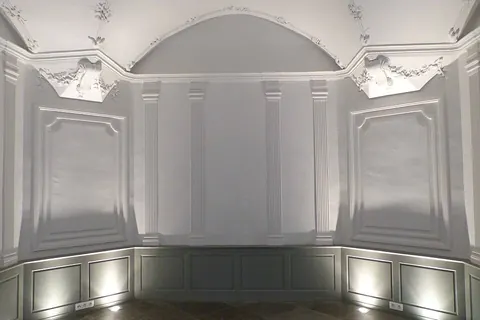

You are now in front of the Hôtel Novi de Caveirac, at 4 bis and 6 Rue Fresque, in the Écusson. Behind a very plain facade lie seven centuries of history. The original building dates back to the fourteenth century. In 1660, work was carried out for Léon Novi, a merchant and adviser to the king, and in 1713 the family became lords of Caveirac. The intendant of the province of Languedoc stayed here when he came to Nîmes. In that same year, 1713, Abbé Jean Novi de Caveirac was born into the family, a polemicist who in 1758 wrote a defence of Louis the Fourteenth over the revocation of the Edict of Nantes, a highly controversial text in a town as Protestant as Nîmes. In 1773, the facade and a drawing room were renovated. In the twentieth century, the architect Chouleur lived here from 1901 to 1985, hence its other name, the Hôtel Chouleur. Then the town of Nîmes became its owner. Look at the facade and imagine, behind it, a large courtyard, a staircase with four newels and three richly decorated drawing rooms. The mansion has been protected as a historic monument since 2004.
History
The mansion dates back to the 14th century. In 1660, work was carried out for Léon Novi, a merchant and adviser to the king; in 1713 the Novi family became lords of Caveirac. In 1773, the facade and a drawing room were renovated. The Mazel family lived there from 1856 to 1901, then the architect Chouleur from 1901 to 1985, when the town of Nîmes became its owner. It was given the highest level of protection as a historic monument in 2004.
Art and architecture
The facade is very plain, the inner courtyard large. The mansion has a fine staircase with four newels, two bedrooms with alcoves and three highly decorated drawing rooms. This contrast between a discreet street front and carefully finished interiors is typical of the mansions of the Écusson.
Anecdotes
Abbé Jean Novi de Caveirac, born in Nîmes on 16 March 1713 and died in Paris in 1782, defended the Jesuit cause. He wrote the Apologie de Louis XIV et de son conseil sur la révocation de l’édit de Nantes (1758) and the Appel à la raison (1762), two works that were very famous in their time.
What to look for
From Rue Fresque, observe the plainness of the facade, renovated in 1773. If the door is open, the large courtyard gives an idea of the size of the residence. The four-newel staircase and the drawing rooms can only be seen during special open days.
Practical
The mansion is at 4 bis and 6 Rue Fresque, a pedestrianised street in the Écusson; OpenStreetMap places it on the corner of Rue de l’Étoile. It is municipal property, generally visible from outside only: check nimes.fr for any open days.
Nearby
Rue Fresque is a stone’s throw from Rue de la Madeleine and the Maison Villaret, and from the Maison Carrée. Lovers of mansions can continue to the Hôtel de Bernis and the Hôtel Rivet, in the same district.
On site, look for: Look at the facade and find the entrance leading to the large inner courtyard.
Test yourself
What other name does the mansion have?
- Hôtel Chouleur (answer)
- Hôtel Rivet
- Hôtel de Bernis
Since when has it been protected as a historic monument?
- 1840
- 1960
- 2004 (answer)
Which high-ranking figure stayed here in Nîmes?
- The bishop of Uzès
- The intendant of Languedoc (answer)
- The king
Sources
Information checked on 6 October 2026.