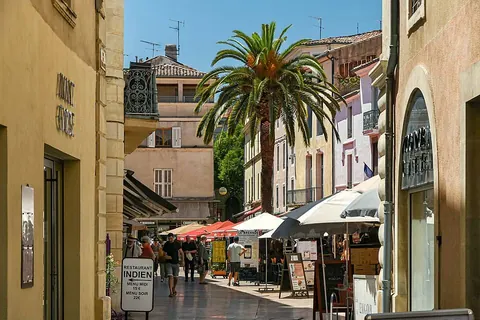

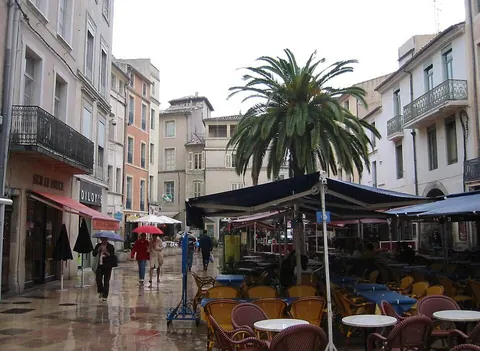
You are on the place du Marché, a small square in the Écusson lined with café terraces. In the centre, the fountain features the crocodile, the emblem of Nîmes. Its origin goes back to antiquity: after the battle of Actium, in 31 BC, coins struck to celebrate Octavian’s victory showed a crocodile chained to a palm, a symbol of Egypt conquered by Rome. In 1535, King Francis the First made the crocodile and the palm tree the city’s coat of arms. The fountain was commissioned in 1986 by the city, under Mayor Jean Bousquet, from the artist Martial Raysse, working with the Italian sculptor Vito Tongiani. It was inaugurated on 14 February 1988. Take a good look at the bronze crocodile: its chain is broken, and it is no longer tied to its palm. The palm tree stands apart on the square. In this way, the artists freed the animal from the symbol of submission. Sit in the shade of the palm tree to take in the scene.
History
The crocodile appears on coins struck after the battle of Actium, in 31 BC, to commemorate the victory of Octavian, the future Augustus. It is chained to a palm and symbolises Egypt conquered by Rome. In 1535, Francis the First officially granted Nîmes its coat of arms with the crocodile and the palm tree.
Art and architecture
At the initiative of Mayor Jean Bousquet, who wanted to combine past and modernity, Martial Raysse created the fountain on the place du Marché, inspired by the crocodile on the arms of Nîmes. The work was made with the Italian sculptor Vito Tongiani. The bronze crocodile sits in the centre of the fountain, while the palm tree stands separately on the square.
Anecdotes
In 1986, the same mayor asked the designer Philippe Starck to modernise the city’s logo, with a stylised crocodile still in use today. Old crocodiles exist too: four crocodiles, dating from the sixteenth to the eighteenth century, hang in the grand staircase of the town hall; they were found in the attic at the end of the nineteenth century and are protected as historic monuments.
What to look for
Walk around the fountain to see the crocodile from several angles. Look for the broken chain, then raise your eyes to the palm tree, deliberately set apart from the animal. Then compare it with the city’s coat of arms, which you will see on the street furniture: there, the crocodile is tied to its palm.
Practical
The square is pedestrian, with free access every day of the year. It lies in the heart of the Écusson, a few minutes’ walk from the Maison Carrée and the Arena. The café terraces around it are a good place for a break.
Nearby
Martial Raysse also redesigned the place d’Assas in 1989, with the figures of Nemausus and Nemausa. Around the place du Marché, several mansions are close by, including the Hôtel de Bernis. At the town hall, see the crocodiles hanging in the grand staircase.
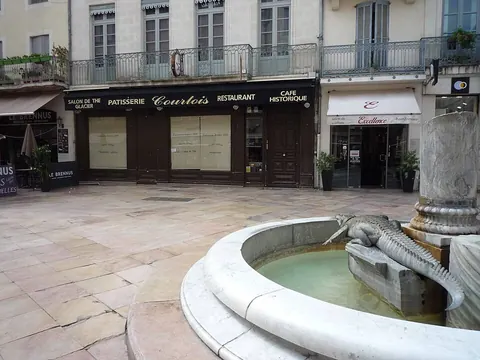


On site, look for: Find the broken link in the crocodile’s chain.
Test yourself
Which animal is the emblem of Nîmes?
- The bull
- The crocodile (answer)
- The eagle
Who designed the fountain with Vito Tongiani?
- Henri Révoil
- Martial Raysse (answer)
- Philippe Starck
Which king set the crocodile coat of arms in 1535?
- Francis I (answer)
- Henry IV
- Louis XIV
Sources
- Nîmes Tourisme: Place du Marché
- Tourisme Gard: La Place du Marché
- Objectif Sud: in search of the totem animal
- Wikipedia: Martial Raysse
Information checked on 6 October 2026.