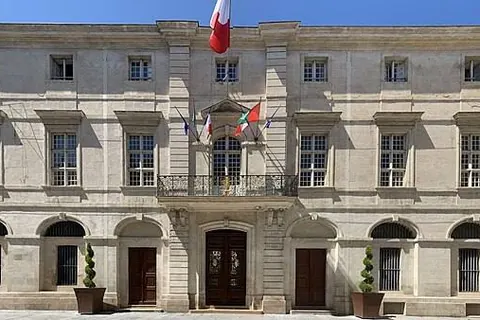

You are in front of the town hall of Nîmes, between the place de l’Hôtel de Ville and rue de la Trésorerie. The name of this street is no accident: in the fourteenth century, the royal Treasury was built here. The town council only moved in between 1700 and 1703, when it left the place de l’Horloge. Jacques Cubizol then enlarged the building, and the Montpellier architect Augustin-Charles d’Aviler is associated with it. The building went on changing: in 1836 and 1837, five windows were added and the façade reached 45 metres. In 1851 and 1852, the staircase received its iron banister. But what everyone comes to see is above this staircase: four stuffed crocodiles, hanging in the air. They were acquired between 1587 and 1703. The crocodile recalls the emblem of the city, linked to Egypt and to the Roman veterans who settled in Nîmes. On the rue de la Trésorerie side, also look up at the Gothic and Renaissance parts, with their ribbed vaults, which recall the age of the Treasury. The building has been listed as a historic monument since 1959.
History
The history of the site begins in the fourteenth century with the construction of the royal Treasury, which left its name to the neighbouring street. The town council only arrived at the very beginning of the eighteenth century: between 1700 and 1703, the town hall left the place de l’Horloge and moved here. Jacques Cubizol then enlarged the existing building, with which the name of Augustin-Charles d’Aviler, an architect based in Montpellier, is associated.
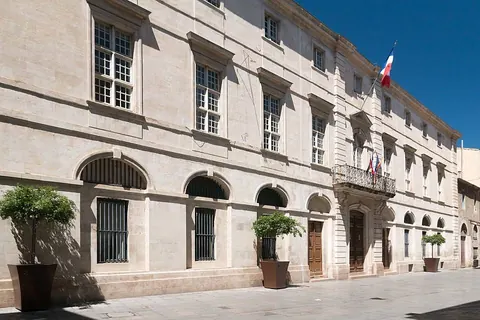
The nineteenth century transformed the building further. In 1836 and 1837, five windows were added and the façade was extended to 45 metres long. In 1851, new embellishments were carried out and the iron banister of the staircase was installed in 1851 and 1852. The last major alterations date from 1956, and the building was listed as a historic monument in 1959.
Art and architecture
The building layers several periods. On the rue de la Trésorerie side, Gothic elements and Renaissance parts can still be seen, with ribbed vaults. The façade on the square, lengthened in the nineteenth century, has a more regular arrangement. Inside, the grand staircase is the centrepiece: its iron banister dates from the middle of the nineteenth century and frames the famous crocodiles hanging above the steps.
Anecdotes
The four stuffed crocodiles were acquired between 1587 and 1703. They refer to the emblem of Nîmes, where the crocodile evokes Egypt and the Roman veterans settled in the colony. Visitors often discover them with surprise: no one expects to find such animals on the ceiling of a town hall. Today they are part of the city’s identity just as much as the Roman monuments.
What to look for
Start with the façade on the square and try to gauge its length, extended to 45 metres in the nineteenth century. Then walk round by rue de la Trésorerie to see the older parts, Gothic and Renaissance, and their ribbed vaults. Inside, stand at the foot of the grand staircase: look up at the crocodiles, then at the design of the iron banister installed in 1851 and 1852.
Practical
The town hall is in the heart of the Écusson, a few minutes’ walk from the Arena and the Maison Carrée. It is a working administrative building: access to the hall and staircase depends on the town hall’s opening hours, to be checked on nimes.fr. Please be discreet, as staff and members of the public are there on business. Seeing the crocodiles only takes a few minutes and is ideal for children.
Nearby
On leaving, the place de l’Horloge, where the old town hall stood before 1700, is very close, as is the place du Marché and its crocodile fountain by Martial Raysse, which continues the theme of the Nîmes emblem. The Arena is a few streets away. The Musée du Vieux Nîmes, on the place aux Herbes, then tells the story of the city and its people.

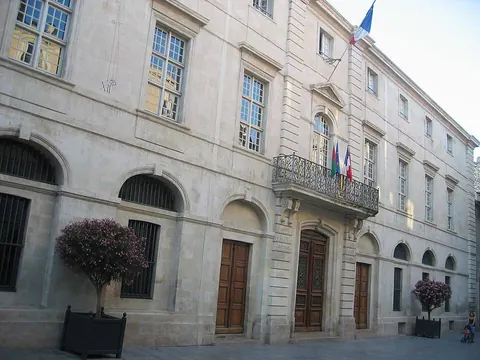

On site, look for: Count the crocodiles hanging above the staircase and find the one that looks biggest to you.
Test yourself
How many stuffed crocodiles hang in the staircase?
- Four (answer)
- Seven
- Two
Which building stood here in the 14th century?
- A convent
- A prison
- The royal Treasury (answer)
Since when has the town hall been a listed historic monument?
- 1840
- 1959 (answer)
- 2001
Sources
Information checked on 6 October 2026.