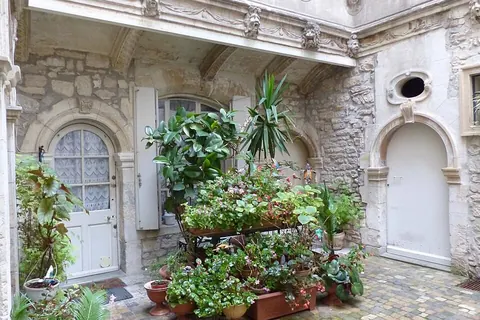

You are in the Écusson, the historic centre of Nîmes. Its name, meaning shield, comes from its shape: seen from above, its outline traces an old heraldic shield. The boulevards around it, laid out in the nineteenth century, follow the line of the medieval wall. Under the Ancien Régime, this centre was divided into five districts: Garrigues, Boucarie, Corcomaires, Prat and Méjean. Where the first four met, the place aux Herbes, in front of the cathedral, was the economic and religious heart of the city. The Méjean district took in the Arena, which had been turned into a fortified castle. From 1775 the medieval rampart was demolished, then, from 1847, new streets were cut through, inspired by Haussmann’s work. Since 1984, the Écusson has been a protected historic district of 41 hectares. The Arena, the Maison Carrée and the Porte d’Auguste stand on the edge of the district. Walk with your eyes raised: restored façades, carved doors, mullioned windows. Several mansions await you, such as the Hôtel de Bernis, one of the oldest in the city.
History
Under the Ancien Régime, the Écusson had five districts: Garrigues, Boucarie, Corcomaires, Prat and Méjean. A fortified wall, punctuated by gates and towers, surrounded them; it was much shorter than the Roman wall, which was more than 6 kilometres long. At the end of the eighteenth century, the architect of the province of Languedoc, Jean-Arnaud Raymond, devised a vast embellishment project. The demolition of the rampart began in 1775 and ended in 1793.
From 1847, new thoroughfares were cut through, inspired by Haussmann’s redevelopment of Paris, such as rue Général-Perrier to the north. In 1984, the city created a protected historic district of 41 hectares; its conservation plan was approved in 2007.
Art and architecture
The district contains many historic monuments, including the cathedral and several mansions. The Hôtel de Bernis keeps a fifteenth-century façade with mullioned windows, and the Romanesque house on rue de la Madeleine, from the twelfth century, displays carved friezes. The Arena, the Maison Carrée and the Porte d’Auguste stand on the edge of the district.
Anecdotes
In the Middle Ages, the Arena, in the Méjean district, had become a fortified amphitheatre, known as castrum arenae. Since 1986, the city has subsidised owners: 1,918 façades have been restored and 1,298 shopfronts renovated.
What to look for
Start from the place aux Herbes and the cathedral, then follow the lanes. Look up to spot the restored façades, the old doors and the mullioned windows. On rue de la Madeleine, look at the friezes of the Romanesque house; on rue de Bernis, the Gothic façade of the Hôtel de Bernis.
Practical
The Écusson is best visited on foot; it is largely pedestrian and freely accessible. The boulevards around it are one-way for cars. Wear good shoes for the cobbles and allow about 40 minutes for a leisurely loop.
Nearby
Along the way: the place de l’Horloge, Les Halles de Nîmes, the place du Marché and its crocodile fountain, the Romanesque house, the Hôtel de Bernis. The city of Nîmes presents the protected district on its official website.
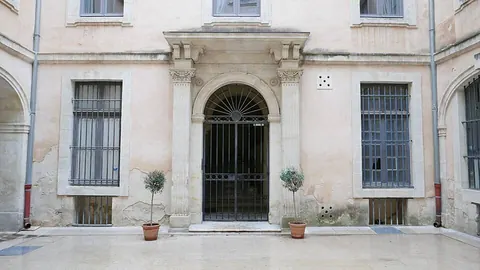

On site, look for: Spot a mullioned window, with its stone cross, on a façade in rue de Bernis.
Test yourself
Where does the name Écusson come from?
- A noble family
- A royal coat of arms
- Its shield shape (answer)
What area does the protected district cover?
- 4 hectares
- 400 hectares
- 41 hectares (answer)
When did the demolition of the medieval rampart begin?
- In 1096
- In 1775 (answer)
- In 1984
Sources
Information checked on 6 October 2026.