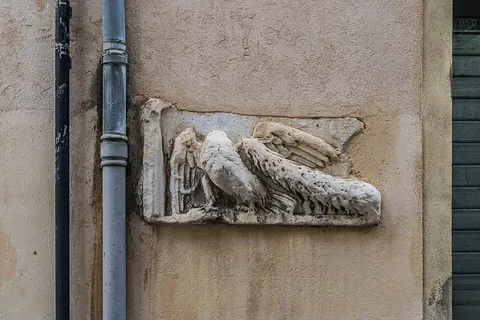
You are now in Rue de l’Aspic, in the old merchant quarter of Les Garrigues. At number 27, look for a detail that many people miss: a carved eagle, set into the wall. Its head is damaged, and it comes from the ruins of a Roman building. The masons reused it as an ordinary stone, and it has been there ever since. Above all, this is the street of the wealthy silk merchants. At number 14, the Hôtel de Fontfroide was remodelled in 1670 for Pierre de Fontfroide, a finance controller; its facade is plain, but its courtyard hides a staircase on four columns with stone balusters. A little further on, at 2 Plan de l’Aspic, the House of the Atlantes was built between 1676 and 1678 for Jean Martin, a silk merchant: two atlantes, carved male figures, hold up the entablature of its doorway. At number 4, the sharp corner of the house was replaced in 1769 by a cut-off corner, with a wavy wrought iron balcony. Walk slowly and look up: every doorway tells the story of a fortune.
History
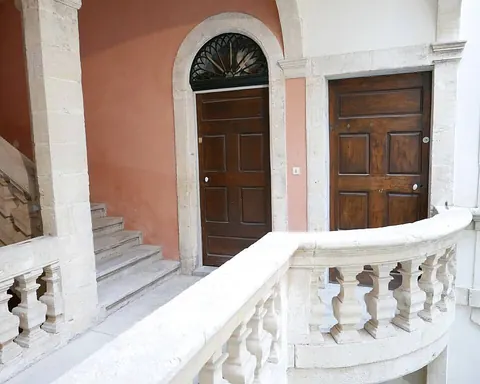
Rue de l’Aspic belongs to the old merchant quarter of Les Garrigues. At 4 Plan de l’Aspic, a house is already mentioned in 1596. In the 17th century, the street attracted great fortunes: the Hôtel de Fontfroide, at number 14, was remodelled in 1670 for Pierre de Fontfroide, a finance controller, then bought in 1695, in very poor condition, by Jacques Mourier, a silk merchant, who had to rebuild the facade to comply with the street alignment.
The street remained a business address until the end of the 20th century: in 1893, the Arnaud-Gaidan bank set up its head office at 10 Rue de l’Aspic. It stayed there until its merger with Crédit du Nord in 1992, after nearly a hundred and fifty years of banking in Nîmes.
Art and architecture
The staircase of the Hôtel de Fontfroide, in the Louis XIII style, turns around a core of four piers linked by arches. Its landings project in quarter circles, supported by brackets, and its balusters are square in section. It is probably the work of Jacques Cubizol, who also worked, with Pierre Cournon, on the house at 2 Plan de l’Aspic, built from 1676 to 1678.
The latter is described as one of the finest examples of Nîmes civil architecture from the time of Louis XIV. Its entrance doorway features two atlantes supporting the architrave, a frieze of foliage scrolls and a cornice; the door leaf is decorated with small panels around a central medallion.
Anecdotes
At 4 Plan de l’Aspic, an inspection in 1767 judged the house dangerous: the architect Chirol found that the timber frame of the upper floors was in danger of collapsing. The work was completed in 1769, and the sharp corner was replaced by a cut-off corner. A balcony door was opened on the first floor, with a wavy balcony in three panels, resting on stone brackets carved with daisies and garlands. This balcony was listed as a historic monument in 1964.
What to look for
At number 27, look for the Roman eagle in the masonry. At number 14, the facade is ordinary: the interest lies in the courtyard, which is private. At 2 Plan de l’Aspic, observe the two atlantes of the doorway, and at number 4, the cut-off corner with its wrought iron balcony and the carved daisies on the brackets.
Practical
The street is pedestrianised and takes just a few minutes to walk from Place du Marché or the Grand’Rue. The mansions are private property: look from the street, without entering the courtyards. The ground is paved but flat, which makes walking easy.
Nearby
Rue de la Madeleine, close by, leads to the Maison Romane. The Hôtel Boudon, in Rue de Bernis, should not be confused with the Hôtel Meynier de Salinelles, at 8 Rue de l’Aspic. To see another of Jacques Cubizol’s projects, walk up to Fort Vauban.
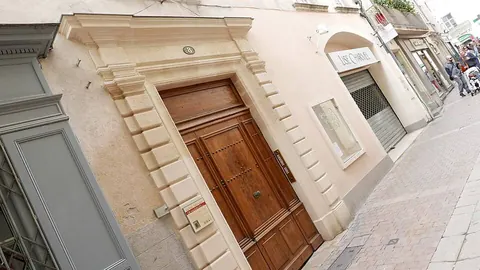


On site, look for: Find the two atlantes holding up the doorway at 2 Plan de l’Aspic.
Test yourself
Which Roman animal is set into the wall at number 27?
- A crocodile
- A lion
- An eagle (answer)
Which trade made the owners in this street rich?
- Salt
- Silk (answer)
- Wine
What do the atlantes at Plan de l’Aspic hold up?
- A balcony
- A fountain
- The entablature of the doorway (answer)
Sources
- Wikipedia: Hôtel de Fontfroide
- POP Mérimée: house, 14 rue de l’Aspic (PA00103128)
- POP Mérimée: building, 27 rue de l’Aspic (PA00103104)
- POP Mérimée: building, 2 plan de l’Aspic (PA00103126)
- POP Mérimée: house, 4 plan de l’Aspic (PA00103127)
- Wikipedia: Banque Arnaud-Gaidan & Cie
Information checked on 6 October 2026.