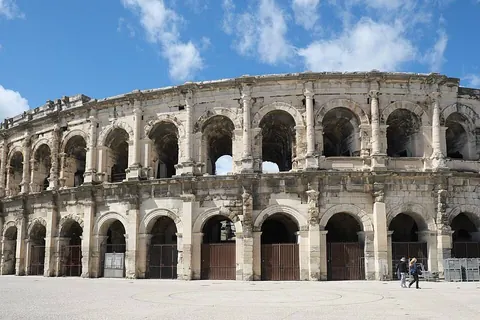

Here you are in front of the Nîmes Arena, a Roman amphitheatre built around 90 AD, probably during the reign of Domitian. The ellipse measures about 133 metres by 101, and stands 21 metres high. The façade lines up 60 arches on each of its two levels. Originally, 24,000 spectators could sit on the 34 rows of tiered seating. After gladiator fights were banned, the building became a Visigothic fortress, then a genuine fortified village, with as many as 220 houses, two churches and a small castle. It was not until 1786 that a decision ordered it to be cleared, a task completed in 1812. Since 1863, the arena has once again hosted shows: bullfights, Camargue races, concerts of the Nîmes Festival and the Roman Days. Look up at the main gate: two bulls’ heads carved in high relief stand above it. Look also, in the stone of the façade, for the she-wolf suckling Romulus and Remus, and two gladiators locked in combat. Since 2009, a long restoration project has been renewing the façades and the seating, bay after bay, and it is due to continue until 2034.
History
Construction of the Arena began around 90 AD and was completed between 90 and 120, probably under Domitian. The amphitheatre then hosted games, including gladiator fights, which were banned in 404. The building then changed its role: it became a Visigothic fortress, then a fortified village called castrum arenae, with two churches, 220 houses and a small castle. People even spoke of the castle of the knights of the arena.
In the early sixteenth century, Francis I visited the monument and recommended clearing it. Yet it took a decree of 28 March 1786 to launch the restoration; the complete clearing was finished in 1812. The amphitheatre was listed as a historic monument in 1840, then converted into a bullring in 1863. Since 2009, a vast campaign has been restoring the façades and seating: 15 bays had been restored by 2022, and the work is due to continue until 2034.
Art and architecture
The outer ellipse measures 133.38 metres by 101.40, and is 21 metres high. The arena floor itself is 69 metres by 38. The façade consists of two levels of 60 superimposed arches. Inside, the seating rises over 34 rows divided into 60 radiating bays, which could hold around 24,000 spectators (some sources say 20,000). Today’s capacity is 13,800 seats, reduced by medieval destruction.
The stone bears several sculptures in low and high relief: a Roman she-wolf suckling Romulus and Remus, two fighting gladiators, two bulls’ heads above the main gate, and carved phalluses, which were protective symbols. Beneath the arena floor, a Latin inscription preserves the name of an architect: T. CRISPIVS REBVRRVS FECIT, meaning Titus Crispius Reburrus made this.
Anecdotes
The Arena is home to a gastropod, the Roman door snail, found nowhere else in France: it is thought to have been imported from Italy during construction. Another curiosity: the Roman Days, held in early May, are presented as the largest historical re-enactment of antiquity in Europe. Finally, since February 2013, access to the monument has been forbidden to unaccompanied visitors for safety reasons.
What to look for
Walk around the outside to compare the restored arches, in pale stone, with those still awaiting their turn. Look above the main gate for the two bulls’ heads, then, on the façade, for the she-wolf and the gladiators. Inside, observe how the seating is arranged in radiating bays and imagine the crowd of antiquity, around twice as large as today’s.
Practical
The Arena stands on Place des Arènes, south of the Écusson, the historic centre. The monument is managed together with the Maison Carrée and the Tour Magne, and a 3 Monuments Pass lets you visit all three. The official website states that the Arena holds the Tourisme et Handicap label for hearing, mental and mobility impairments. Check the opening hours and prices on arenes-nimes.com before you come, as the monument closes during shows.
Nearby
Just opposite, the Museum of Roman History (Musée de la Romanité), at 16 boulevard des Arènes, displays the city’s ancient collections and offers a terrace overlooking the amphitheatre. Heading north through the Écusson, you will reach the Maison Carrée, another major Roman monument. To go further, the Tour Magne and the Jardins de la Fontaine complete the ancient trail.
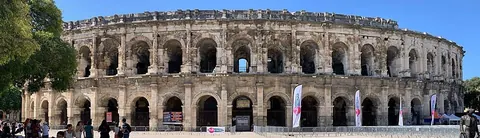

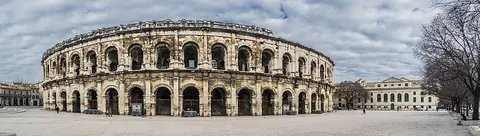

On site, look for: Walk around the façade and find the two bulls’ heads above the main gate.
Test yourself
How many arches are there on each level of the façade?
- 40
- 60 (answer)
- 80
How many houses did the medieval village inside the Arena contain?
- 1,000
- 220 (answer)
- 50
In which year was the clearing of the Arena completed?
- 1650
- 1812 (answer)
- 1905
Sources
Information checked on 6 October 2026.