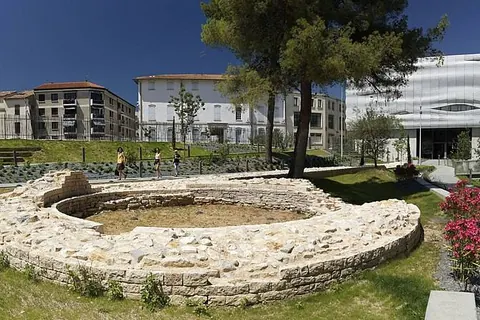

You are now in the archaeological garden of the Museum of Roman History, the Musée de la Romanité, opposite the Arena. To get here, you may have crossed the museum by its internal street. This street is not laid out at random: it follows the line of the rampart that the emperor Augustus had built around the town in about 15 before the common era, a wall more than six kilometres long, flanked by eighty towers. And the garden holds the proof: the foundations of the Augustan rampart, with a tower, are part of the route. This garden of 3,500 square metres reads like a history book, on three levels that correspond to three great periods. The pre-Roman level brings together olive, fig and almond trees. The Roman level offers lavender, thyme, cypress, laurels, box, rosemary and acanthus, the leaf that decorates Corinthian capitals. The medieval level grows peach, plum, tarragon and chives. The museum itself opened on 2 June 2018, in a building designed by Elizabeth de Portzamparc. Stroll from one level to the next, and take a close look at the stones of the rampart.
History
In about 15 BC, Augustus had Nîmes encircled by a rampart more than six kilometres long, flanked by around eighty towers. The Musée de la Romanité, opened on 2 June 2018 opposite the Arena, was built with this past in mind: its internal street follows the line of the rampart, and the foundations of the Augustan wall, with a tower, are part of the garden.
Art and architecture
The garden, covering 3,500 square metres, is organised on three levels corresponding to three periods: pre-Roman (olive, fig, almond), Roman (lavender, thyme, garlic, chestnut, acanthus, cypress, laurels, box, rosemary) and medieval (peach, tarragon, chives, plum). It complements the architecture of Elizabeth de Portzamparc, a pleated toga of glass whose strips evoke a mosaic.
Anecdotes
The museum project grew out of the rescue excavations of 2006 and 2007 under the Allées Jaurès: a domus and two mosaics, Achilles and Pentheus, were discovered there in excellent condition. Specialists describe them as the finest pieces after those of Pompeii. Elizabeth de Portzamparc’s design won against those of Rudy Ricciotti and Richard Meier.
What to look for
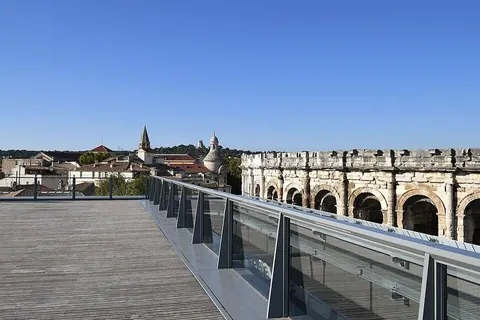
Spot the foundations of the rampart and the tower, then compare the three levels of planting. From the museum’s internal street, you pass beneath the remains of the propylaeum of the Fontaine sanctuary before reaching the garden. The museum’s roof terrace offers a 360 degree view over the town.
Practical
The garden is free to enter, separate from the paid museum visit, at 16 Boulevard des Arènes. Opening times change with the season: check them on museedelaromanite.fr. OpenStreetMap shows the museum as wheelchair accessible.
Nearby
The Arena is just opposite. To follow Augustus’s rampart elsewhere in town, head to the Porte de France, the Porte d’Auguste and the Tour Magne. Inside the museum, do not miss the Bellerophon mosaic and the Pentheus mosaic.



On site, look for: Find an acanthus leaf in the garden, then look for the same motif on an ancient capital.
Test yourself
How many levels does the garden have?
- One
- Seven
- Three (answer)
Which Roman remains are part of the garden?
- A theatre
- An aqueduct
- Augustus’s rampart (answer)
When did the museum open?
- In 1900
- In 2005
- In 2018 (answer)
Sources
- Objectif Gard: at the Musée de la Romanité, there is also the archaeological garden (2020)
- Wikipedia: Musée de la Romanité, Nîmes
- Wikipedia: Roman walls of Nîmes
- Musée de la Romanité, official website
Information checked on 6 October 2026.