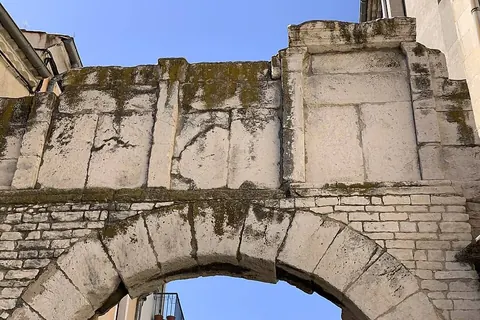

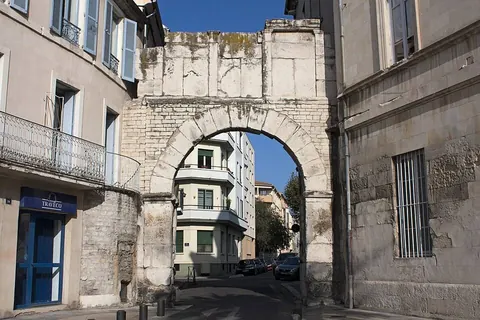
You are standing in front of the Porte de France, a Roman gate built in the first century before Christ. It belonged to the wall that surrounded Nemausus, the Nîmes of antiquity. According to the tourist office, this rampart from the time of Augustus was about 7 kilometres round, protected 220 hectares, and its walls stood 9 metres high. Around a dozen gates opened into the city. Today only two are still visible: the Porte d’Auguste and this one. The Porte de France was not a major entrance. It served a secondary road, and not the Via Domitia towards Spain, as people long believed. Even so, it was fitted with a portcullis and, in antiquity, flanked by two round towers. Look at its single passage, with its rounded arch. Above it, raise your eyes to the blind gallery: you can still make out the remains of four pilasters and a cornice. The street that runs through it bears its name, rue de la Porte de France. The monument has been listed as a historic monument since the list of 1840.
History
The Porte de France dates back to the first century before Christ. The tourist office dates it more precisely to 16 to 15 BC. It was part of the long Roman wall of Nîmes, which had around a dozen gates. It was not one of the main entrances: that role fell to the Porte d’Auguste and the Porte du Cadereau. It was long thought to open onto the Via Domitia towards Hispania, but the discovery of the Porte du Cadereau showed that it served a secondary road instead.
Art and architecture
The gate has a single passage covered by a rounded arch. The upper part forms a blind gallery decorated with Tuscan pilasters, of which the remains of four pilasters and a cornice can still be seen. In antiquity, the opening was flanked by two round towers, now gone. Despite its modest role, it was fitted with a portcullis, a grille that slid vertically to close the passage.
Anecdotes
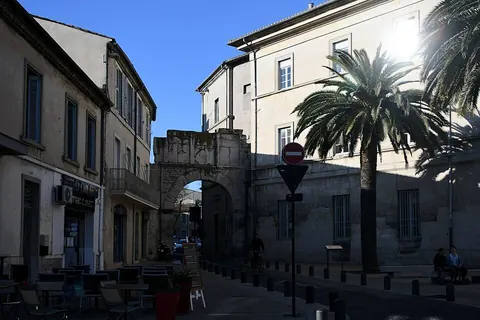
There were probably several gates of this kind in the city, but this is the only one to have survived. It owes its fame less to its original importance than to its state of preservation. It was also protected very early, as it appears on the 1840 list of historic monuments. It also gave its name to the street that runs through it.
What to look for
Stand in line with the street to see the whole arch, then move closer. Look at the size of the blocks in the passage, the regular curve of the arch, then the horizontal line of the cornice at the top. Look for the vertical reliefs of the pilasters, discreet but still legible. Finally, imagine on each side the two round towers that framed the entrance.
Practical
The gate is in the open air, on rue de la Porte de France, a few minutes’ walk from the Arena. There is no ticket and no opening times: the monument is viewed from the street. Watch out for traffic, as the street is open to vehicles. Since 2024, there has been talk of making it pedestrian.
Nearby
To compare, head to the Porte d’Auguste, the other Roman gate still visible, which was more important at the time. The Arena is very close. To find out more, the Nîmes tourist office presents the Augustan wall and its remains, and the Mérimée record of the Ministry of Culture describes the monument.


On site, look for: Count the remains of pilasters above the arch: you should find four.
Test yourself
What period does the Porte de France date from?
- 12th century
- 17th century
- 1st century BC (answer)
How many Roman gates are still visible in Nîmes?
- Six
- Twelve
- Two (answer)
What shape is its passage?
- A pointed arch
- A rounded arch (answer)
- A square opening
Sources
Information checked on 6 October 2026.