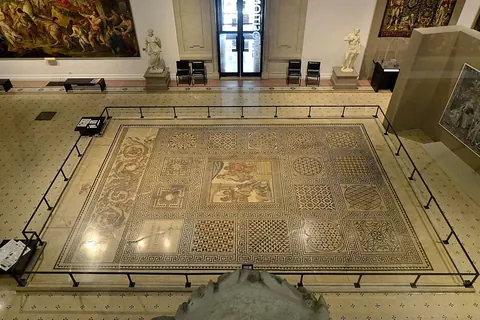

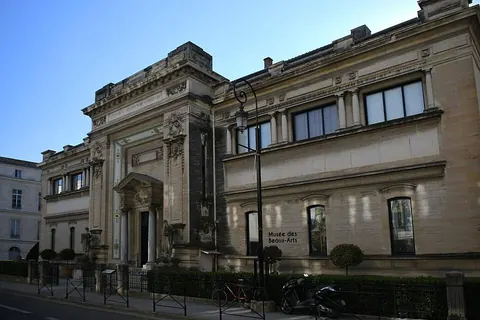
You are in front of the Fine Arts Museum of Nîmes, the Musée des Beaux-Arts, on rue de la Cité Foulc, about a hundred metres from the Arena. The museum was founded in 1821, at first inside the Maison Carrée. The present building came out of a competition launched in 1902 and won by a Nîmes architect, Max Raphel: it was built from 1903 to 1907. In 1987, Jean-Michel Wilmotte renovated it and gave it an atrium under a glass roof, which lights the galleries from above. The collections bring together about 3,800 works, mainly from the Italian, Northern and French schools. You will come across painters such as Jacopo Bassano, Rubens, Carel Fabritius, François Boucher and Paul Delaroche. Don’t miss the Antony and Cleopatra cycle by Charles-Joseph Natoire, nor the glazed terracotta Virgin and Child by Andrea della Robbia. But the most famous piece is Roman: a second-century mosaic of more than 50 square metres showing the wedding of Admetus. Take the time to look at its details.
History
The Fine Arts Museum was founded in 1821 and originally housed in the Maison Carrée. At the beginning of the twentieth century, the city decided to give it a building of its own: an architecture competition was held in 1902, won by Max Raphel from Nîmes. Construction lasted from 1903 to 1907, on rue de la Cité Foulc, very close to the Arena. In 1987, the architect Jean-Michel Wilmotte renovated the building. It was directed from 2001 to 2023 by Pascal Trarieux, then by Barbara Gouget from 2024.
Art and architecture
The collections comprise about 3,800 works from the fourteenth to the nineteenth century: paintings, sculptures and decorative arts. The Italian school is represented notably by Jacopo Bassano and Lelio Orsi, the Northern schools by Rubens and Carel Fabritius, the French school by François Boucher, Charles-Joseph Natoire and Paul Delaroche. Natoire’s Antony and Cleopatra cycle and Andrea della Robbia’s Virgin and Child surrounded by cherubs, a glazed terracotta from the late fifteenth century, are among the major pieces. The museum’s masterpiece remains the Roman mosaic of the wedding of Admetus, dated to the second century AD, which covers more than 50 square metres.
Anecdotes
Max Raphel’s building was transformed in 1987 by Jean-Michel Wilmotte, who added an atrium under a glass roof: light falls from the sky, an ideal overhead lighting for the works. In 2026, the museum is hosting the exhibition “Lumières et Ténèbres” (Light and Darkness), devoted to water and featuring more than 80 works, as well as “Adieu Beauté” (Farewell Beauty), ephemeral snow sculptures by Alix Boillot.
What to look for
Start with the atrium and its glass roof, then look for the great mosaic of the wedding of Admetus: observe the composition, the border and the fineness of the small stones. In the painting galleries, find Natoire’s Antony and Cleopatra cycle, then Andrea della Robbia’s Virgin and Child, in glazed terracotta. Save some time for the Northern painters.
Practical
Address: 20 bis rue de la Cité Foulc, about a hundred metres from the Arena. Opening times checked on 6 October 2026 on nimes.fr: Tuesday to Friday 10 am to 6 pm, Saturday and Sunday 10 am to 6:30 pm, closed on Mondays. The museum is wheelchair accessible, with a lift, hearing loops and QR codes describing the works. An annual pass at 40 euros gives access to the city’s six museums.
Nearby
The Arena is just round the corner, and the Museum of Roman History (Musée de la Romanité) continues the discovery of ancient Nîmes. The six museums of Nîmes are within a radius of about one kilometre, so you can visit several on foot in a day, such as the Musée du Vieux Nîmes or Carré d’Art.

On site, look for: Find the mosaic of the wedding of Admetus and estimate its area by counting your steps along one side.
Test yourself
Which architect built the museum?
- Augustin-Charles d’Aviler
- Jean Nouvel
- Max Raphel (answer)
Which century does the mosaic of the wedding of Admetus date from?
- 12th century
- 18th century
- 2nd century (answer)
Where was the museum housed when it was founded in 1821?
- In the Arena
- In the Maison Carrée (answer)
- In the Tour Magne
Sources
- Wikipédia : Musée des Beaux-Arts de Nîmes
- City of Nîmes: Fine Arts Museum
- City of Nîmes: Museums and planetarium
Information checked on 6 October 2026.