
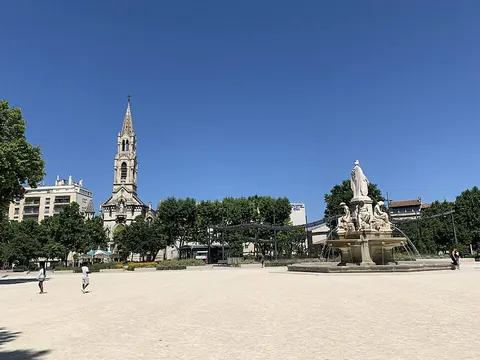
Here you are in front of the church of Saint Perpetua and Saint Felicity, on the edge of the Esplanade Charles-de-Gaulle. Look up: its spire rises 71 metres above the esplanade. It is a Second Empire church, in the eclectic style, designed by the architect Léon Feuchère. The foundation stone was laid in October 1852 by Louis-Napoléon Bonaparte, a few weeks before he became the emperor Napoleon III. The main structure was finished in the autumn of 1862, the fittings in 1864, and the church was consecrated in June of that same year. At the top of the spire, a wrought-iron cross measures 8 metres, but 5 of those metres are embedded in the stone: so you only see a small part of it. If the door is open, go in. The nave has three aisles and six bays, covered by rib vaults, and it rises to more than 20 metres. In the choir, look for the twelve stained-glass windows: they depict the twelve apostles. The choir has three levels of elevation, the nave only two, a difference that is easy to see from the entrance. Then step back out facing the esplanade: you are a stone’s throw from the Pradier fountain and from avenue Feuchères, which runs down to the station.
History
The church was built under the Second Empire, on the edge of the esplanade that the Nîmes town council decided to lay out in 1841, together with avenue Feuchères. The foundation stone was laid in October 1852 by Louis-Napoléon Bonaparte, then prince-president. The work lasted about ten years: the main structure was finished in the autumn of 1862, the interior fittings in 1864, and the consecration took place in June 1864.
The name brings together two Christian martyrs, Perpetua and Felicity. The people of Nîmes therefore often call the building simply Sainte-Perpétue, but its full title recalls both saints together.
Art and architecture
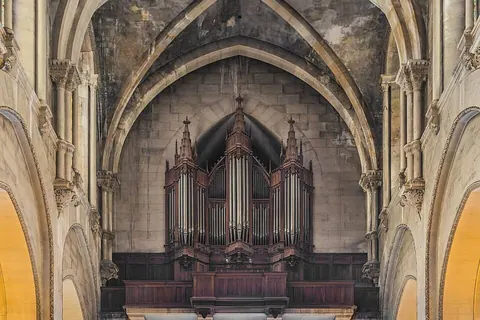
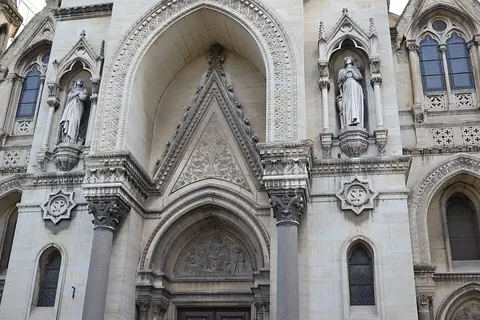
The architect was Léon Feuchère. He adopted an eclectic style, typical of the Second Empire, drawing on the Gothic vocabulary: pointed quadripartite rib vaults, a tall spire, a strong sense of verticality. The nave is divided into three aisles and has six bays; it rises to more than 20 metres.
The plan includes two oriented chapels, the southern one dedicated to the Virgin. The elevation differs between the nave, on two levels, and the choir, on three levels, which gives more light and height at the far end of the church. The choir has twelve stained-glass windows devoted to the twelve apostles.
Anecdotes
The wrought-iron cross at the top of the spire measures 8 metres, but 5 metres are embedded in the masonry: the part visible from the ground therefore looks far more modest than it really is.
The architect Léon Feuchère has almost the same name as General Feuchères, after whom the neighbouring avenue is named: the resemblance is a coincidence, and the two names are in fact spelt differently.
What to look for
From the esplanade, step back to see the whole spire: it rises 71 metres above the garden. Inside, compare the nave and the choir: two levels of elevation on one side, three on the other. Look for the south chapel, dedicated to the Virgin, then the twelve apostle windows in the choir.
Practical
The church stands on the edge of the Esplanade Charles-de-Gaulle, a few minutes’ walk from the station along avenue Feuchères, and next to the Arena. Opening hours for visits are not fixed: outside services, please ask the parish or the tourist office. Please be discreet during celebrations.
Nearby
Just in front, the Pradier fountain, the work of the sculptor James Pradier inaugurated in 1851, represents the city of Nîmes. Avenue Feuchères runs down to the station, and the Arena is a few steps to the west. To learn more, the church’s Wikipedia page details its plan and elevation.


On site, look for: In the choir, count the stained-glass windows and try to recognise an apostle by his attribute.
Test yourself
Who laid the church’s foundation stone in 1852?
- Louis-Napoléon Bonaparte (answer)
- The bishop of Uzès
- The mayor of Nîmes
How high does the spire rise above the esplanade?
- 110 metres
- 45 metres
- 71 metres (answer)
What do the twelve stained-glass windows in the choir depict?
- The bishops of Nîmes
- The months of the year
- The twelve apostles (answer)
Sources
- Wikipedia: Église Sainte-Perpétue et Sainte-Félicité de Nîmes
- Wikipedia: Esplanade Charles-de-Gaulle (Nîmes)
Information checked on 6 October 2026.