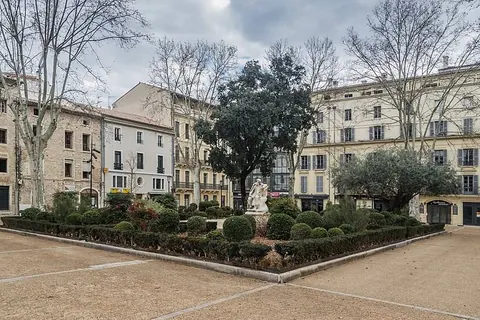
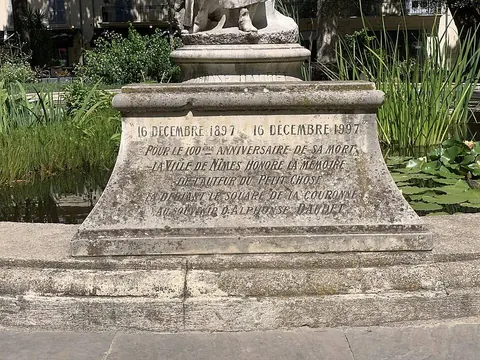
You are now in the Square de la Couronne, at the eastern corner of the Écusson, between Boulevard Amiral-Courbet and the esplanade. In the centre, a statue watches the people of Nîmes go by: it is Alphonse Daudet, born in Nîmes on 13 May 1840, the author of Letters from My Windmill and Monsieur Seguin’s Goat. His family unveiled it here three years after his death in 1897. But the square has another, more passionate secret. In December 1914, Guillaume Apollinaire was sent to Nîmes for his military training. He was madly in love with Louise de Coligny-Châtillon, whom he nicknamed Lou. She joined him for a week, and at the Hôtel du Midi, on this square, the poet lived what the tourist office calls the ten most passionate days of his life. This square is one of the nineteenth century developments that came with the grand boulevards, created when the old ramparts were demolished. Today, restaurant terraces fill the space. Walk around the statue, and look out for the facades of the old hotel district.
History
The Square de la Couronne is one of the 19th century developments that accompanied the grand boulevards, themselves created by the demolition of the old ramparts in the 18th century, like the Square de la Bouquerie and the Square Antonin. It borders the Écusson, between Boulevard Amiral-Courbet and the Esplanade Charles-de-Gaulle.
Art and architecture
The statue of Alphonse Daudet, a native of Nîmes, was unveiled by his family three years after his death. Daudet, born in Nîmes on 13 May 1840 and died in Paris on 16 December 1897, was the author of Letters from My Windmill and the play La Dernière Idole. The monument is listed on Wikimedia Commons as the Monument to Alphonse Daudet.
Anecdotes
Guillaume Apollinaire fell in love with Louise de Coligny-Châtillon, whom he nicknamed Lou. When he was sent to Nîmes for his military training, after his application to enlist was accepted in December 1914, she joined him there for a week. According to Tourisme Gard, the poet spent the ten most passionate days of his life at the Hôtel du Midi, on this square.
What to look for
Look at the statue of Daudet, then at the layout of the square and the terraces around it. Today the place offers its gentle space to the terraces of a few restaurants: a good place to pause between the esplanade and the old town.
Practical
The Square de la Couronne is open access all year round. It is a few minutes’ walk from the Arena, the Esplanade Charles-de-Gaulle and the Grand Temple. The area is flat and pedestrianised in places.
Nearby
The Grand Temple, a former Dominican convent that became a Protestant temple in 1803, is very close, on Boulevard Amiral-Courbet. To follow in Daudet’s footsteps, look in Nîmes for the boulevard that bears his name and the Maison Sabran, on the Grand-Cours, where he was born.
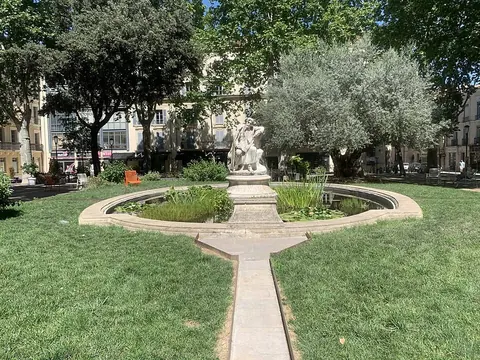


On site, look for: Walk around the statue of Alphonse Daudet and work out which direction he is looking in.
Test yourself
Which writer has a statue in the square?
- Alphonse Daudet (answer)
- Victor Hugo
- Émile Zola
What did Apollinaire call his beloved?
- Lili
- Lou (answer)
- Mimi
In what year was Daudet born in Nîmes?
- 1802
- 1840 (answer)
- 1897
Sources
- Tourisme Gard: the Square de la Couronne
- Wikipedia: Alphonse Daudet
- Wikipedia: Guillaume Apollinaire
- Wikipedia: Louise de Coligny-Châtillon
- Wikipedia: History of Nîmes
Information checked on 6 October 2026.