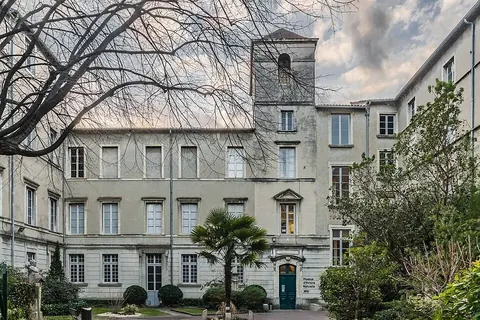

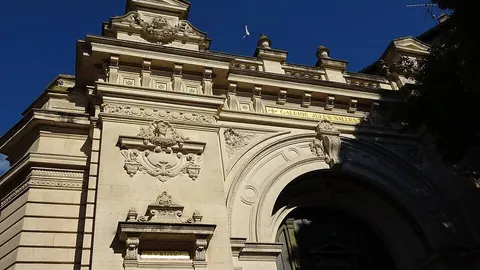
You are in front of the Museum of Natural History and Prehistory of Nîmes, at 13 boulevard Amiral-Courbet. It occupies part of the former Jesuit college, around a cloister and a listed seventeenth-century chapel. The museum was inaugurated in 1895. Its collections are among the richest in France: it ranks sixth nationally, with more than 700,000 specimens in geology, prehistory, ethnology, zoology and botany. At its origin lies, in particular, the personal collection of a Nîmes scholar, Jean-François Séguier. Today, four main themes are presented to the public: local prehistory, the geology of the south of France, ethnography as it was displayed in the 1930s, and zoology. In the zoology rooms, you will come across mammals, birds, fish and insects. The nearby Jules-Salles gallery hosts a temporary exhibition every year. In summer, the museum advises coming in the morning, as opening times may change in very hot weather.
History
The museum was inaugurated in 1895. It is based in particular on the personal collection of Jean-François Séguier, a Nîmes scholar. It moved into the former Jesuit college, a seventeenth-century complex arranged around a cloister, whose chapel is listed as a historic monument. The college also housed an archaeology museum and the municipal library. The museum is a municipal museum holding the Musée de France label. It is home to the Society for the Study of Natural Sciences of Nîmes and the Gard, founded on 17 November 1871. It welcomed about 39,595 visitors in 2016, compared with a peak of 65,417 in 2010.
Art and architecture
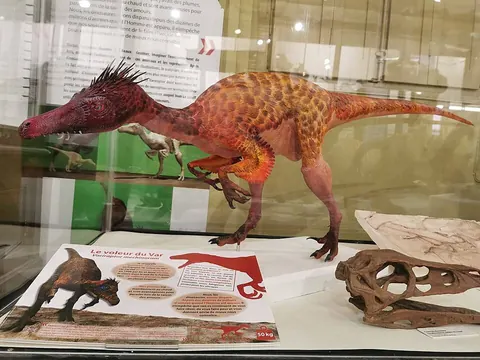
The collections cover prehistory, from the Mousterian to the Bronze Age, zoology with mammals, birds, fish and arthropods, ethnology from Africa, Oceania and Asia, and geology. In all, more than 700,000 specimens, placing the museum sixth nationally. The present rooms show four themes: local prehistory, geology of the south of France, ethnography of the 1930s and zoology.
Anecdotes
The museum forms a whole with the Planetarium on Mont Duplan and a DNA School. It has a research library of 45,000 books. One of the themes presented is the ethnography of the 1930s, and a temporary science exhibition is held every year in the neighbouring Jules-Salles gallery.
What to look for
Start with the geology gallery, on the ground floor, devoted to the geology of the south of France. Continue with local prehistory, then the ethnography and zoology rooms. Take the time to look at the cloister of the Jesuit college, around which the museum is arranged. If a temporary exhibition is on at the Jules-Salles gallery, it rounds off the visit nicely.
Practical
The museum is open: as of 6 October 2026, nimes.fr announces no closure for works and no relocation. Address: 13 boulevard Amiral-Courbet. Opening times checked on 6 October 2026: Tuesday to Friday 10 am to 6 pm, Saturday and Sunday 10 am to 6:30 pm, closed on Mondays and some public holidays. Times may change in very hot weather: in summer, it is best to come in the morning. Only the ground-floor geology gallery is wheelchair accessible, as there is no lift.
Nearby
The Jesuit Chapel, on the Grand’Rue, belongs to the same complex and hosts exhibitions and concerts. To continue the science theme, the Planetarium is on Mont Duplan. The Musée du Vieux Nîmes and the cathedral are a few minutes’ walk away. The city’s six museums can be visited with an annual pass at 40 euros.


On site, look for: In the geology gallery, find the oldest rock or fossil given on the labels.
Test yourself
In which year was the museum inaugurated?
- 1678
- 1895 (answer)
- 1982
What national rank do its collections hold?
- 1st
- 20th
- 6th (answer)
Which Nîmes scholar is at the origin of the collections?
- Henry Bauquier
- Jean-François Séguier (answer)
- Max Raphel
Sources
- Wikipedia: Muséum d’histoire naturelle de Nîmes
- City of Nîmes: Museum of Natural History and Prehistory
- Nîmes Tourisme : Musée d’histoire naturelle
Information checked on 6 October 2026.