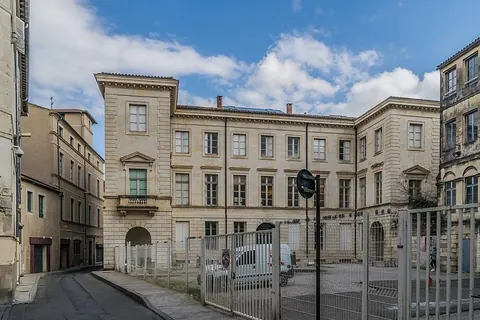

You are now at 10 Grand’Rue, in front of the Hôtel Rivet. It was built in 1786 for David Rivet, a silk merchant. Three years later the Revolution broke out, and the house would change its purpose far more often than its owner could ever have imagined: a hospital, the prefecture in 1822, a convent in 1857, then a girls’ school. Since 1985, it has been home to the Nîmes School of Fine Arts. Among its former students, you may know the singer Julien Doré or the actor Damien Bonnard. Look at the architecture: very regular, monumental facades, two wings forming a U, and a neoclassical style inspired by Palladio, with Tuscan columns. Inside, a staircase with a wrought iron banister completes the whole. The building was listed as a historic monument in 1988, then given the highest level of protection in 2005. As you pass, compare this plain, symmetrical facade with the older mansions of the Écusson: here we are at the very end of the Ancien Régime, when taste was turning back to Antiquity.
History
The mansion was built in 1786 for David Rivet, a silk merchant, at a time when Nîmes lived off its textile industry. The architect’s name remains uncertain: Jean-Arnaud Raymond is sometimes suggested, without certainty. After the Revolution, the building became a hospital, then the prefecture in 1822, a convent in 1857, and finally a girls’ school.
The Nîmes School of Fine Arts was founded here in 1985. The building was listed as a historic monument in 1988, then given the highest level of protection in 2005. Since 2023, the school has been headed by Delphine Paul.
Art and architecture
The very regular, monumental facades and the two wings arranged in a U belong to a neoclassicism inspired by Palladio, that is to say by the Italian architect Palladio and by Antiquity. Note the Tuscan order columns, the plainest of the classical orders, and a staircase with a wrought iron banister. The whole contrasts with the more ornate 17th century mansions of the Écusson.
Anecdotes
Few houses in Nîmes have had so many roles. In less than two centuries, a silk trader’s home cared for the sick, housed the prefecture’s administration, sheltered a religious community and taught girls, before training artists. The school’s former students include the singer Julien Doré, the actor Damien Bonnard, the engraver Jean-Marie Granier and the artist Thibault Brunet.
What to look for
From the Grand’Rue, observe the symmetry of the facade and the regular rhythm of the openings. If the door is open, look for the U-shaped layout of the wings around the courtyard and the Tuscan columns. The wrought iron staircase can only be seen from inside.
Practical
The mansion is at 10 Grand’Rue, in the Écusson, a few minutes’ walk from the Place aux Herbes. The school is a teaching establishment: the interior is only accessible during its public events, exhibitions or open days. Check with the school before visiting.
Nearby
The Grand’Rue leads towards Place Belle-Croix and the cathedral area. To continue the theme of silk merchants, head to Rue de l’Aspic, where several 17th century mansions were built for traders. The Museum of Old Nîmes tells the story of the Nîmes textile industry.
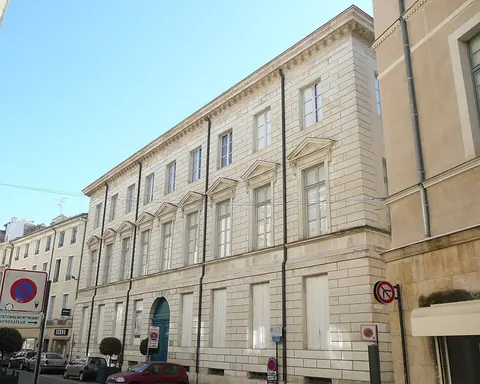

On site, look for: Spot the Tuscan columns and the U shape formed by the two wings.
Test yourself
Who was the mansion built for?
- A bishop
- A general
- A silk merchant (answer)
Which institution occupies it today?
- A hospital
- The prefecture
- The school of fine arts (answer)
Which singer studied here?
- Charles Aznavour
- Johnny Hallyday
- Julien Doré (answer)
Sources
Information checked on 6 October 2026.