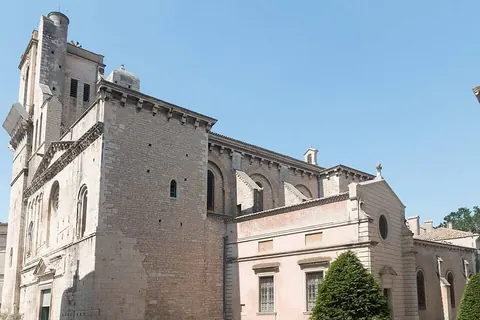

You are on the place aux Herbes, in front of the Cathedral of Notre-Dame-et-Saint-Castor, seat of the diocese of Nîmes, Uzès and Alès. In the Middle Ages, this square was the economic and religious heart of the city. The Romanesque church was consecrated in 1096 by Pope Urban the Second. During the Wars of Religion it was badly damaged in 1567 and again in 1621, and one of the two towers of the façade was destroyed. The building was rebuilt in the seventeenth century under Bishop Cohon, then, between 1877 and 1882, the architect Henri Révoil decorated the interior in a Romano-Byzantine style. Look at the façade: at the top, a triangular pediment in the antique manner, and a Romanesque frieze telling the story of the Old Testament; its first seven scenes are still visible. The neoclassical doorway dates from 1822. The north tower, about 40 metres high, escaped destruction and served as a lookout post. Inside, look for the Baroque Rosary chapel at the end of the choir, and the tomb of Cardinal de Bernis in the third chapel on the south side.
History
Excavations in 1920 revealed, to the west of the façade, the remains of a seventh-century church, and many sarcophagi show burial use up to the twelfth century. In the Carolingian period, an episcopal group dedicated to the Virgin, Saint Stephen and Saint John stood here.
The Romanesque church was consecrated in 1096 by Urban the Second. Damaged by the Reformers in 1567 and 1621, it lost its south tower, known as the Treasury tower. In the seventeenth century, Bishop Cohon had the building rebuilt, and Protestants helped to finance the nave. It became a minor basilica in 1882 and was listed as a historic monument in 1906.
Art and architecture
From the Romanesque period there remain a gable wall with a former bell gable, Lombard bands and the triangular pediment in the antique manner, typical of Provençal Romanesque art, with its Old Testament frieze. The seventeenth-century interior forms a single nave with side chapels and ribbed vaulting, 20 metres high under the vault and 55 metres long. Révoil decorated it in a Romano-Byzantine style between 1877 and 1882.
The organ was built from 1643 onwards by Gaspard and André Eustache. Its case, carved by Christophe Noiratte and Michel Péru, was listed in 1968. Restored by Alfred Kern and inaugurated in 1983, the instrument has 51 stops and four keyboards.
Anecdotes
The destroyed Treasury tower was comparable to the Fenestrelle tower in Uzès, but square in plan and taller, according to the drawings of Poldo d’Albenas in the sixteenth century. The reused antique blocks and columns long led people to believe the cathedral was built on a Roman monument. Despite its title, the building remains modest: the church of Saint-Baudile is larger in area.
What to look for
On the façade, spot the triangular pediment and the Romanesque frieze, then the neoclassical doorway of 1822. Look up at the north tower: its top storey is Gothic and it ends in a flat roof terrace. Inside, look for the Rosary chapel, crowned by a lantern, the early Christian sarcophagus panel and the tomb of Cardinal de Bernis in the third south chapel, then the great organ case and its cherubs.
Practical
The cathedral is on the place aux Herbes, in the heart of the Écusson, a few minutes’ walk from the place de l’Horloge. It is a place of worship: visit in silence and outside services. Opening times are not given here; check the cathedral’s website or the tourist office before you come.
Nearby
Close by, on rue de la Madeleine, the Romanesque house also dates from the twelfth century. The place de l’Horloge and the Hôtel de Bernis, the cardinal’s family home, are a few minutes away. To find out more, the city’s Archaeological Museum holds fragments of capitals from the Carolingian episcopal group.
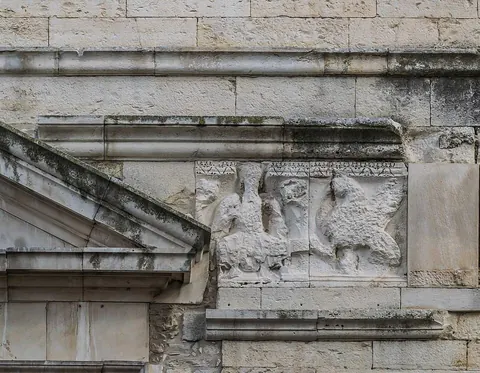


On site, look for: On the frieze of the façade, try to count the carved scenes that can still be made out.
Test yourself
Who consecrated the Romanesque church in 1096?
- Charlemagne
- Francis I
- Pope Urban II (answer)
How many stops does the great organ have?
- 100
- 12
- 51 (answer)
Which cardinal has his tomb in the cathedral?
- Cardinal Mazarin
- Cardinal Richelieu
- Cardinal de Bernis (answer)
Sources
Information checked on 6 October 2026.