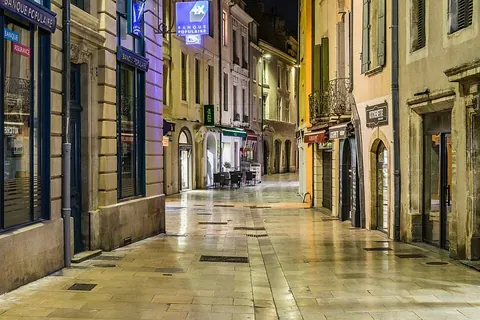
You are now in Rue de la Madeleine, a stone’s throw from the cathedral. At number 1 stands a house whose exact origin nobody knows. Was it the residence of a priory, or the home of a wealthy townsman? The archives do not say. What is certain is its facade: on the first floor, old arcades have been blocked up, and the walls have been decorated with reused pieces of sculpture. This is the Maison Romane, protected since 1939. In its courtyard, four balconies are stacked one above the other; the first bears the date 1637, and a Romanesque column with its capital decorates the third. The whole street is a small museum of ironwork. At number 13, on the corner of Rue de l’Aspic, a wrought iron balcony is listed as a historic monument. At number 27, it is a staircase with its wrought iron banister, and at number 35, another balcony. Walk on slowly and look up: the finest details are above the shop windows.
History
Rue de la Madeleine links the cathedral area with the shopping heart of the Écusson. Its oldest building is the house at number 1, known as the Maison Romane. The Ministry of Culture’s record states that its origin is not documented: it may have been the residence of a priory or the home of a wealthy inhabitant. Its sculptures were listed as historic monuments by an order of 3 October 1939.
Art and architecture
On the first floor of the street facade, arcades have been blocked up and the walls decorated with reused sculpted fragments. The 1939 listing covers precisely these sculptures, as well as a small column and its capital set on the rail of the third balcony in the courtyard. This courtyard brings together four stacked balconies, the first of which is dated 1637.
The street also has several protected pieces of ironwork: the corner balcony at number 13, where it meets Rue de l’Aspic, listed in 1964; the staircase with its wrought iron banister at number 27, listed in 1964; and the wrought iron balcony at number 35, listed in 1965.
Anecdotes
Reuse is the key to the Maison Romane: rather than cutting new stones, its builders incorporated older sculptures into the facade. Even the Romanesque column in the courtyard was reused to decorate a 17th century balcony. The house therefore mixes several periods in a single wall.
What to look for
At number 1, compare the sculpted fragments on the first floor and look for the shape of the blocked-up arcades. Then carry on looking above the shop fronts: the corner balcony at number 13, then, further along, the ironwork at numbers 27 and 35.
Practical
A pedestrianised shopping street, accessible at any time, with a flat surface. The buildings are private: the courtyard of the Maison Romane and the staircase at number 27 are not open to the public, so look from the street. Avoid the busiest shopping hours if you want to study the facades in peace.
Nearby
The Place aux Herbes and the cathedral are at the end of the street. Rue de l’Aspic, which crosses Rue de la Madeleine at number 13, has several 17th century mansions. The Maison Romane entry in this guide describes the facade of number 1 in detail.
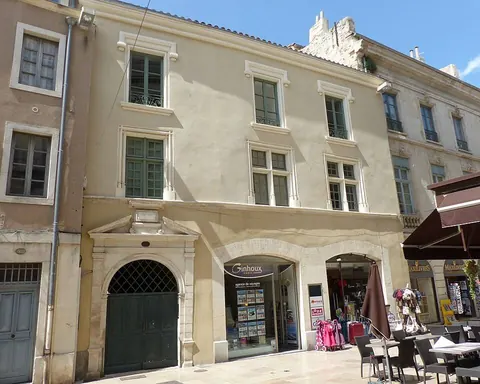
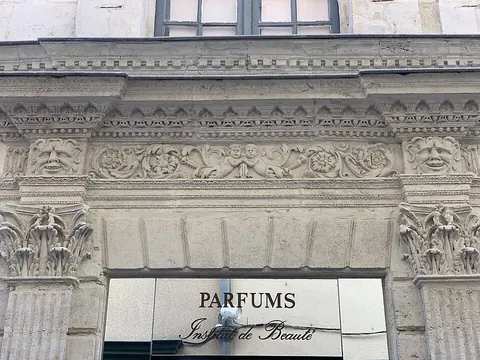


On site, look for: At number 1, spot the blocked-up arcades on the first floor, then find the corner balcony at number 13.
Test yourself
What date is on the first balcony in the courtyard of the Maison Romane?
- 1096
- 1637 (answer)
- 1789
Since when has the Maison Romane been protected?
- 1840
- 1939 (answer)
- 2005
What is protected at number 27?
- A fountain
- A staircase and its banister (answer)
- A statue
Sources
- POP Mérimée: building, 1 rue de la Madeleine (PA00103113)
- Wikipedia: List of historic monuments in Nîmes
Information checked on 6 October 2026.