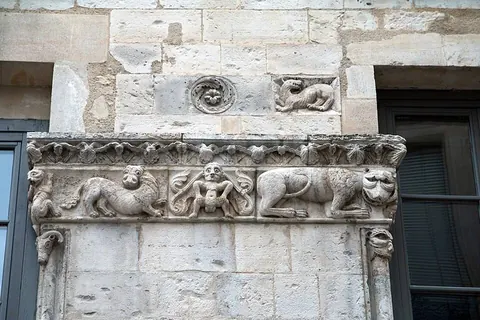
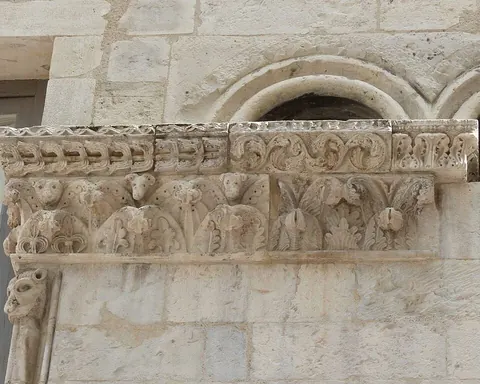
You are at number 1 rue de la Madeleine, a stone’s throw from the cathedral, in front of the Romanesque house. It was built in the twelfth century, which makes it one of the oldest homes in the city. Its origin remains a mystery: it may have been a residence linked to a priory, or the house of a wealthy townsman. The façade is built of large dressed stones. Look up at the first floor: you can see Romanesque decoration of great delicacy, made of carved cornices and small columns. Look at the acanthus leaves, the fantastic animals, an eagle, a ram’s head, monsters’ heads and even a face with a moustache. These elements have been moved: in the nineteenth century, the present windows were opened to modernise the house, and the friezes were reassembled differently. Look for the remains of arches: they help you imagine the original Romanesque floor, with paired windows. The house has been listed as a historic monument since 1939.
History
The house was built in the twelfth century. Its original use is unknown: a residence dependent on a priory or the house of a wealthy townsman. The upper parts were rebuilt in the seventeenth century, as shown by a date marked in the mortar found during the 1999 restorations. In the nineteenth century, new windows were opened. The house was listed as a historic monument in 1939.
Art and architecture
The façade is in large-block dressed stone. The first floor bears Romanesque decoration considered remarkably executed, made of elements that have been moved: carved cornices forming imposts, with acanthus leaves, fantastic animals, plant motifs, a human face and animal heads; small columns topped by a ram’s head, monsters’ heads, an eagle or a face; friezes adorned with a moustached face, scrolling acanthus and flowers.
Anecdotes
The carved friezes are no longer in their original place: they were moved in the nineteenth century, when the present windows were opened to bring the house up to date. Historians describe it as an enigmatic medieval house.
What to look for
Step back in the street to see the whole first floor. Spot the carved cornices, then move closer to study each motif: acanthus, monsters, eagle, ram, faces. Finally, look for the remains of rounded arches, which betray the former paired windows.
Practical
The house is at 1 rue de la Madeleine, a pedestrian street in the Écusson, a few steps from the cathedral. It is private property: the façade is viewed from the street, with no visit inside.
Nearby
Continue to the Cathedral of Notre-Dame-et-Saint-Castor, whose façade also keeps a Romanesque frieze. The Hôtel de Bernis and the place de l’Horloge are a few minutes away. To go further, Antoine Bruguerolle’s study in the 1999 Congrès archéologique de France analyses this façade.
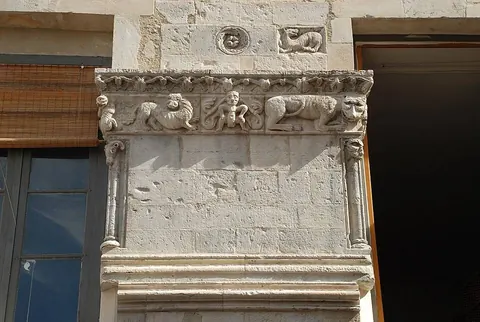


On site, look for: Find the carved face with a moustache on the façade.
Test yourself
Which century does the Romanesque house date from?
- 12th century (answer)
- 15th century
- 19th century
When were the present windows opened?
- In 1939
- In the 12th century
- In the 19th century (answer)
Which animal is carved on a small column?
- A bull
- A crocodile
- An eagle (answer)
Sources
Information checked on 6 October 2026.