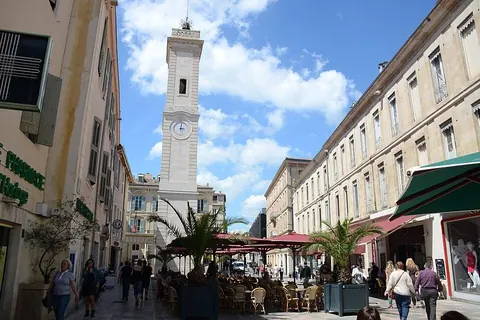

You are on the place de l’Horloge, in the heart of the Écusson. The tower in front of you is 31 metres high. It was rebuilt from 1752 to 1754, on the site of an older fifteenth-century belfry: so a clock has set the rhythm of life in this district for about five centuries. Look up at the top. On the terrace, a wrought-iron bell cage shaped like a crown surrounds the bell that strikes the hours. The square is also linked to Jean Nicot, a native of Nîmes. Ambassador in Lisbon from 1559, he introduced tobacco to Europe, a plant first called nicotiana, after his name. Now lower your gaze to the ground. In 2003 the square was redesigned with new paving, a fountain set flush with the ground and lighting synchronised with coloured light displays. Take the time to walk around it: the nearby streets lead to the cathedral, the church of Saint-Paul and several mansions.
History
A belfry stood here as early as the fifteenth century. The present tower replaced it: it was rebuilt from 1752 to 1754. Tourisme Gard points out that the square has therefore been marking time for about five centuries. The square is associated with Jean Nicot, born in Nîmes, ambassador in Lisbon from 1559, who introduced tobacco to Europe.
Art and architecture
The tower is 31 metres high. It ends in a terrace carrying a wrought-iron bell cage shaped like a crown, enclosing the hour bell. At ground level, the 2003 redesign brought new paving, a fountain set flush with the ground and lighting synchronised with coloured light displays, which bring the square to life.
Anecdotes
The plant that Jean Nicot introduced was first called nicotiana, after his own name, before becoming known as tobacco. His name lives on today in the word nicotine. A story of worldwide vocabulary that begins with a child of Nîmes who became a diplomat in Portugal.
What to look for
Look at the outline of the tower, then the wrought-iron crown and the bell it protects. Then look for the clock face. On the ground, spot the fountain jets set flush with the paving. If you come by after dark, stay a few minutes to watch the lights change colour.
Practical
The square is pedestrian, with free access every day of the year. It lies between the Maison Carrée and the cathedral, a few minutes’ walk from each. The tower cannot be visited: it is viewed from the square. Beware of the wet ground near the fountain.
Nearby
The Cathedral of Notre-Dame-et-Saint-Castor and the church of Saint-Paul are very close. Les Halles de Nîmes are also very close. Several mansions of the Écusson, including the Hôtel de Bernis, can be discovered by strolling through the neighbouring lanes.
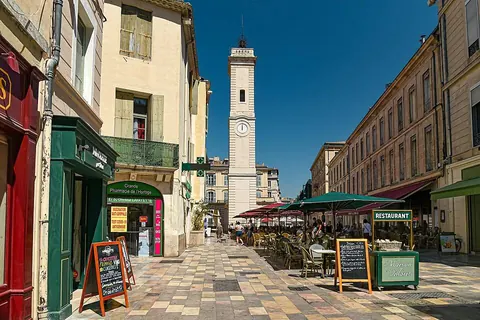

On site, look for: Spot the hour bell inside the wrought-iron crown at the top of the tower.
Test yourself
How tall is the clock tower?
- 12 metres
- 31 metres (answer)
- 80 metres
When was the present tower rebuilt?
- From 1752 to 1754 (answer)
- In 1096
- In 2003
Which man from Nîmes introduced tobacco to Europe?
- Henri Révoil
- Jean Bousquet
- Jean Nicot (answer)
Sources
Information checked on 6 October 2026.