
You are now on the Place aux Herbes, in front of the cathedral. Go up close to its facade: you will see square holes in it. They were cut so that the street traders of the Middle Ages could hang their vegetable stalls on them. Hence the name of the square, the herb square. For centuries, this was the heart of Nîmes: people gathered here for assemblies, processions formed here, and the square also witnessed tragedies during the Wars of Religion. The cathedral itself bears the marks: it was badly damaged in 1567 and again in 1621, and one of its two bell towers, the Treasury Tower, was demolished. Look up at the facade: a Romanesque frieze runs above the doorway, and its first seven panels can still be made out. They tell scenes from the Old Testament. On the side of the square, the former bishops’ palace, rebuilt at the end of the seventeenth century, has housed the Museum of Old Nîmes since 1920. Sit down for a moment at a café terrace: today the square is still a busy crossing point for students and locals alike.
History
The cathedral that closes off the square stands on the site of a Romanesque church consecrated in 1096 by Pope Urban II, whose construction probably continued into the 12th century. The present building is the result of several major campaigns. During the Wars of Religion, it was badly damaged twice by the Protestants, in 1567 and 1621. It was raised to the rank of minor basilica in 1882 and listed as a historic monument in 1906.
According to the tourist office, for centuries the square was the heart of the town: assemblies were held here, processions were organised here and pagan festivals took place here.
Art and architecture
The cathedral facade bears a triangular pediment in the classical style. Its left-hand section shows Old Testament scenes in low relief: this is the Romanesque frieze, whose first seven panels remain visible. Opposite, the former bishop’s palace was rebuilt at the end of the 17th century under Bishop Jean-Jacques Séguier de La Verrière, with influences from northern France. It was listed as a historic monument in 1986.
At number 2 on the square, wrought iron balconies have been listed as historic monuments since 1963: a fine example of Nîmes ironwork.
Anecdotes
Medieval traders had no fixed shops: they attached their stalls directly to the cathedral, using square holes cut into the facade. The Place aux Herbes takes its name from this vegetable trade. Another reminder of the Wars of Religion: the cathedral had two bell towers, but the Treasury Tower, on the south side, was demolished during the violence of the 16th and 17th centuries.
What to look for
On the facade, look for the square holes, then read the panels of the Romanesque frieze from left to right. Next, spot the remaining bell tower and imagine its vanished twin. Finally, turn towards the former bishop’s palace and the wrought iron balconies of number 2.
Practical
The square is pedestrianised, in the heart of the Écusson, and accessible at any time. The ground is paved: with a pushchair or a wheelchair, keep to the area around the cathedral. To visit the cathedral or the Museum of Old Nîmes, check opening hours on their official websites.
Nearby
The Museum of Old Nîmes, founded in 1920 by the scholar Henry Bauquier, devotes a room to serge de Nîmes, the ancestor of denim. A few steps away, Rue de la Madeleine leads to the Maison Romane, and the Place de l’Horloge continues the walk.
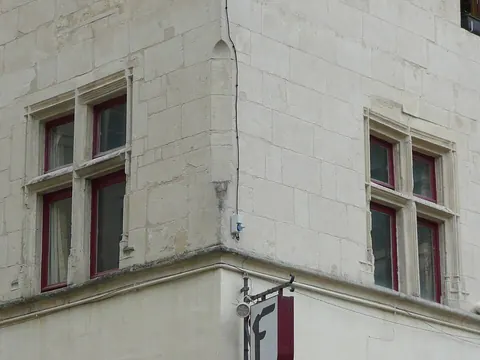

On site, look for: Find the square holes of the old stalls on the cathedral facade, then count the panels of the Romanesque frieze.
Test yourself
What were the square holes in the facade used for?
- Fixing stalls (answer)
- Housing birds
- Supporting scaffolding
Which museum stands on the square?
- The Carré d’Art
- The Museum of Old Nîmes (answer)
- The Musée de la Romanité
Which of the cathedral’s bell towers has disappeared?
- The Clock Tower
- The Tour Magne
- The Treasury Tower (answer)
Sources
- Nîmes Tourisme: Place aux Herbes
- Wikipedia: Nîmes Cathedral (Notre-Dame-et-Saint-Castor)
- Wikipedia: Museum of Old Nîmes
- Wikipedia: List of historic monuments in Nîmes
Information checked on 6 October 2026.