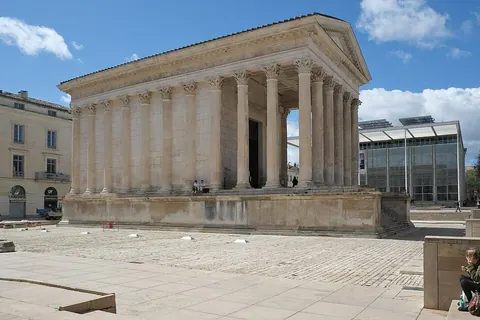

Here you are in front of the Carré d’Art, facing the Maison Carrée. This building of glass, concrete and steel is the work of the British architect Norman Foster. He won the 1984 international competition against rivals such as Jean Nouvel, Frank Gehry, Arata Isozaki and César Pelli. The Carré d’Art opened on 9 May 1993. It brings two institutions together under one roof: a museum of contemporary art and the city’s media library, on the model of the Centre Pompidou in Paris. The museum holds around 600 works, created from the 1960s onwards. The library has around 380,000 volumes, including 70 incunabula and 800 manuscripts. The building stands on the site of a neoclassical theatre built between 1798 and 1800 and destroyed by fire in October 1952. Its colonnade was dismantled and moved. Look at the dialogue between the two façades: two thousand years apart, the ancient temple and the modern portico answer each other across the square.
History
The site was occupied by a neoclassical theatre, built from 1798 to 1800 and destroyed by fire in October 1952. Its colonnade was later dismantled and reinstalled elsewhere. In 1984, the city launched an international architecture competition for a new cultural venue; Norman Foster won against César Pelli, Arata Isozaki, Jean Nouvel and Frank Gehry. The Carré d’Art opened on 9 May 1993.
Art and architecture
Foster used glass, concrete and steel. The building combines two functions, in the manner of the Centre Pompidou: a museum of contemporary art and the municipal media library. The museum brings together around 600 works of contemporary art dating from after 1960. The library holds around 380,000 volumes, 70 incunabula and 800 manuscripts.
The façade on the square takes up the idea of a columned portico, echoing the Maison Carrée opposite. The contrast is deliberate: the lightness of metal and the transparency of glass on one side, the mass of ancient stone on the other.
Anecdotes
Attendance at the museum reached 53,355 visitors in 2017, counting free and paid admissions together. In 2024, the museum was directed by Hélène Audiffren, and the library by Valérie Travier.
What to look for
From the square, look at the façade of the Carré d’Art, then turn back towards the Roman temple to grasp the mirror effect. Beneath the portico, notice how slender the metal columns are. If you go inside, let yourself be guided by the natural light that flows through the building, and check the exhibition programme on the official website.
Practical
The Carré d’Art is on Place de la Maison Carrée. The museum is open Tuesday to Friday from 10 am to 6 pm, Saturday and Sunday from 10 am to 6.30 pm, and closed on Mondays; it is also closed on 1 January, 1 May, 1 November, 11 November and 25 December (official website, checked on 6 October 2026). Prices are not shown on the home page: please check carreartmusee.com.
Nearby
The Maison Carrée is just opposite. The Quais de la Fontaine start nearby and lead to the Jardins de la Fontaine. To continue with art, the Museum of Fine Arts and the Museum of Old Nîmes round off a visit to the city.
On site, look for: Stand beneath the portico of the Carré d’Art and compare its slender columns with those of the Maison Carrée opposite.
Test yourself
Which architect designed the Carré d’Art?
- Frank Gehry
- Jean Nouvel
- Norman Foster (answer)
In which year did the Carré d’Art open?
- 1975
- 1993 (answer)
- 2005
Which building occupied the site before it?
- A market
- A railway station
- A theatre (answer)
Sources
Information checked on 6 October 2026.