

Here you are in front of the Maison Carrée, a Roman temple built during the reign of Augustus and completed around the years 2 and 3 AD. It is one of the best preserved Roman temples. It was dedicated to Gaius and Lucius Caesar, the adopted sons of Augustus, known as the princes of youth. The building rests on a podium 2.65 metres high, reached by 15 steps. It is surrounded by 30 Corinthian columns, each 9 metres tall; only the six on the façade stand completely free, while the others are set into the wall. Over the centuries, the temple served as the seat of the town government, a dwelling, a stable, a church and then a prefecture, before becoming an archaeological museum from 1824. In 1758, the Nîmes scholar Jean-François Séguier reconstructed the lost inscription on the façade from the fixing holes of its bronze letters. Look at the frieze and the architrave: the little holes are still there. Since 18 September 2023, the Maison Carrée has been a UNESCO World Heritage Site.
History
The Maison Carrée was built during the reign of Augustus, between 10 BC and 4 AD; dating by the consuls named in the inscription places its completion around the years 2 and 3. The temple was dedicated to Gaius and Lucius Caesar, consuls designate, sons of Augustus and princes of youth.
Its survival owes much to its successive uses. From the eleventh to the sixteenth century, it served as the seat of the municipal government, the Capitole. It then became a dwelling, a stable, and later the church of the Augustinians. From 1792 to 1807, it hosted revolutionary meetings and then the prefecture, and from 1824 an archaeological museum. A major restoration took place from 2006 to 2011, and the monument was inscribed as a UNESCO World Heritage Site on 18 September 2023.
Art and architecture
It is a hexastyle temple, with six columns on the façade, and pseudo-peripteral: the columns along the sides and at the back are set into the walls of the cella. The order is Corinthian, recognisable by the capitals decorated with acanthus leaves. The building is 26.42 metres long and 13.54 wide; the inner hall, the cella, measures 10.50 metres by 16. The podium rises to 2.65 metres, and a staircase of 15 steps leads to the pronaos. The 30 columns are each 9 metres tall.
Anecdotes
The dedication inscription vanished long ago, but in 1758 Jean-François Séguier reconstructed it by studying the position of the holes used to fix the bronze letters. The restoration from 2006 to 2011 required more than 44,000 hours of work. The Maison Carrée is the 51st French site inscribed on the World Heritage List.
What to look for
Stand facing the staircase to appreciate the proportions of the six-column façade. Move closer to the architrave and frieze to spot the fixing holes of the letters. Then walk around the temple: you will see that the side columns are half embedded in the wall, the hallmark of a pseudo-peripteral plan. Finally, look at the acanthus leaves of the Corinthian capitals.
Practical
The temple stands in the heart of Place de la Maison Carrée, in the north-west of the Écusson. The square is freely accessible, so you can admire the exterior at any time. For a visit inside, check the opening hours and prices on arenes-nimes.com; the 3 Monuments Pass covers the Maison Carrée, the Arena and the Tour Magne. The official website mentions a Tourisme et Handicap label for hearing and mental impairments.
Nearby
Just opposite, Norman Foster’s Carré d’Art, opened in 1993, reinterprets the ancient portico in glass and steel. Following the Quais de la Fontaine westwards, you will reach the Jardins de la Fontaine, the Temple of Diana and the Tour Magne. The Arena lies to the south, at the other end of the Écusson.


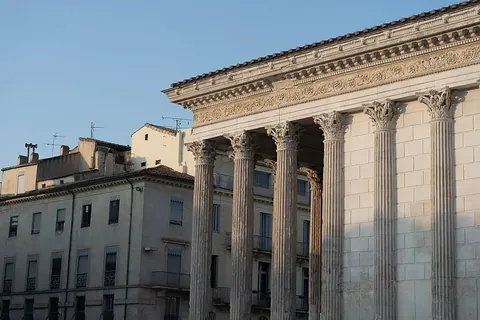

On site, look for: Count the columns on the façade, then spot on the architrave the little holes left by the old bronze letters.
Test yourself
To whom was the temple dedicated?
- Gaius and Lucius Caesar (answer)
- Julius Caesar
- Nero
How many columns surround the temple?
- 12
- 30 (answer)
- 48
Since when has the Maison Carrée been a World Heritage Site?
- 1985
- 2010
- 2023 (answer)
Sources
Information checked on 6 October 2026.