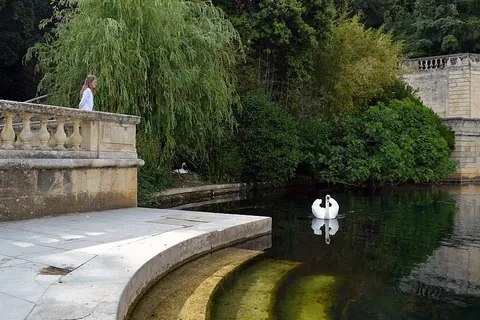

You are on the quai de la Fontaine, alongside the canal that flows from the Jardins de la Fontaine. It all began in 1738: the city wanted to improve its water supply and decided, on 19 July, to have the basin of the spring dug out and cleaned. The works, directed from 1739 by the engineer Jean de Clapiès, uncovered major Roman remains: a sanctuary dedicated to Augustus, a portico around a pool, and a theatre. In 1740, the plan by the architect Dardalhion was chosen, and a royal decree entrusted the direction of the works to the military engineer Jacques Philippe Mareschal. The gardens and their canals were built between 1745 and 1755, keeping the main layout of the ancient site. The canal you are walking along is part of this system, with its regulating channels and pools that carry the water from the spring towards the city. Look at the balustrades along the water, the row of plane trees and the classical façades that form a long perspective up to the gardens and to Mont Cavalier, where the Tour Magne stands.
History
In 1738, Nîmes was looking to improve the city’s water supply. On 19 July, the council decided to have the basin of the spring dug out and cleaned and to reopen the old Roman aqueducts. From 1739, the engineer Jean de Clapiès directed these works, which revealed a sanctuary dedicated to Augustus, a portico surrounding a pool and an ancient theatre. On 24 October 1740, a commission chose the plan by the architect Dardalhion. A royal decree of 20 December 1740 entrusted the direction of the works to Jacques Philippe Mareschal, military engineer to Louis the Fifteenth. The gardens were built between 1745 and 1755. Mareschal imposed a strict condition: to keep the main layout of the ancient complex.
Art and architecture
The whole was designed as a French formal garden centred on the spring. The project includes two half-moon staircases going down to the spring, a double staircase climbing to the upper terrace, the canal of the quai de la Fontaine, as well as regulating channels and pools. The quays are lined with balustrades and planted with plane trees, with buildings with classical façades forming an orderly perspective.
Anecdotes
The garden’s sculptures have an unexpected origin: in the 1740s, ten Medici-style vases and eight marble statues arrived from the Château de la Mosson, in Montpellier. They are the work of the sculptor Nicolas Sébastien Adam. The gardens were listed as a historic monument as early as 1840, then the whole site, including what lies underground, in 1991. They also hold the Remarkable Garden label.
What to look for
Walk along the canal watching the water: it comes from the ancient spring at the far end of the gardens. Notice the design of the balustrades and the regularity of the façades lining the quay. As you walk up towards the gardens, the perspective narrows onto the spring, the half-moon staircases and, higher up, Mont Cavalier crowned by the Tour Magne.
Practical
The quay is a public space with free access at any time. It links the city centre to the entrance of the Jardins de la Fontaine. The walk follows the water under the plane trees. The gardens themselves have their own opening times, to be checked on nimes.fr. Take care with children near the water.
Nearby
At the end of the quay, the Jardins de la Fontaine hold the spring of Nemausus and the Temple of Diana. Climbing Mont Cavalier, you reach the Tour Magne and its panorama. In the other direction, the square Antonin and its statue of the emperor mark the way back to the Écusson and the Maison Carrée.
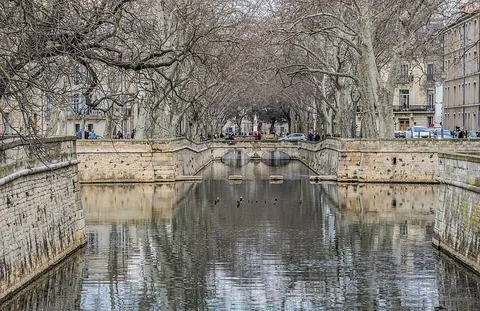

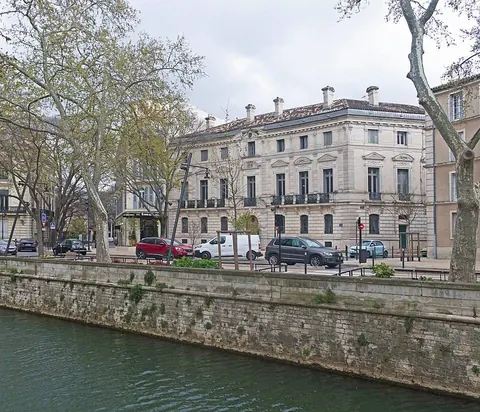

On site, look for: Walk up the quay towards the gardens and notice the moment the Tour Magne appears above the trees.
Test yourself
Which military engineer directed the project?
- Jacques Philippe Mareschal (answer)
- Jean Nouvel
- Max Raphel
Between which years were the gardens and canals built?
- 1600 and 1610
- 1745 and 1755 (answer)
- 1890 and 1900
Where does the canal’s water come from?
- The Fontaine spring (answer)
- The Rhône
- The sea
Sources
Information checked on 6 October 2026.