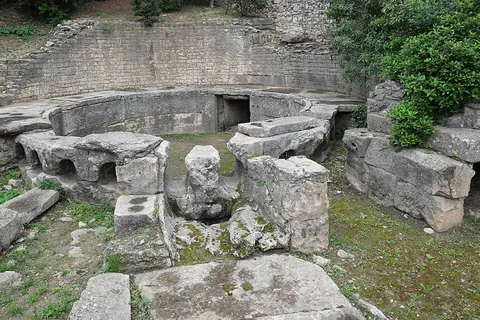

Here you are in front of the castellum aquae, on rue de la Lampèze. This is where the water of the Roman aqueduct of Nîmes arrived, after a journey of around 50 kilometres from the Eure spring, across bridges and through tunnels, including the famous Pont du Gard. This water tower was not used to store water but to distribute it. Look at the circular basin, nearly 6 metres across. In its wall, ten openings 40 centimetres in diameter took lead pipes that ran off to the different districts of the ancient city. At the bottom, three drain holes let the overflow escape. Below the level of the pipes, the basin held only 16 cubic metres of water. The monument dates from the first century AD. It was damaged in 1688 during the building of the nearby Vauban fort, then uncovered in 1844 by Auguste Pellet. It has been a listed historic monument since 1875. It is one of the rare surviving examples of this type of Roman structure.
History
Built in the first century AD, the castellum received the aqueduct’s water from the Eure spring, around 50 kilometres away, by way of the Pont du Gard. In 1688, the construction of the neighbouring Vauban fort damaged it. It was uncovered in 1844 by Auguste Pellet, then listed as a historic monument in 1875.
Art and architecture
The structure is a circular basin nearly 6 metres across. Ten openings of 40 centimetres fed lead pipes towards the districts of Nemausus. Three plug holes at the bottom of the basin were used to drain the overflow. Below the level of the outlets, the basin held only 16 cubic metres: its role was distribution, not storage.
Anecdotes
The Pont du Gard, one of the most famous Roman monuments, was only one section of this aqueduct, which ended discreetly here, north of the Écusson. This castellum is a precious testimony to Roman hydraulic expertise.
What to look for
Lean over the railing to see the round basin. Spot the ten circular openings in the wall and, at the bottom, the three drain holes. Look also for the channel where the aqueduct arrived.
Practical
The remains are on rue de la Lampèze, north of the historic centre; they can be seen from the street. The visit is short, about ten minutes is enough.
Nearby
The Pont du Gard, an excursion from Nîmes, shows the most spectacular part of the aqueduct. In town, the Tour Magne and the Jardins de la Fontaine lie to the west, and the Museum of Roman History (Musée de la Romanité) tells the story of ancient Nîmes.
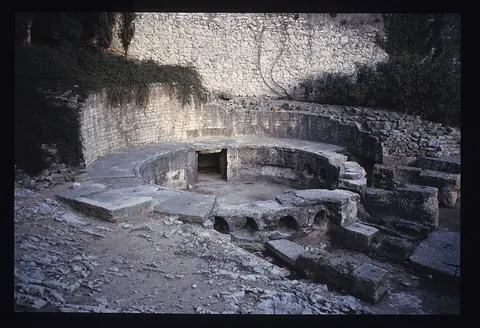

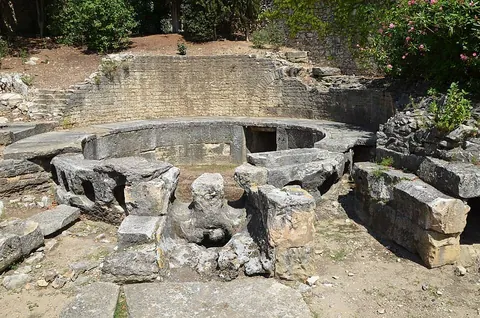

On site, look for: Count the round openings in the wall of the basin: you should find ten.
Test yourself
Where did the water come from?
- The Eure spring (answer)
- The Rhône
- The sea
How many openings distributed the water?
- 10 (answer)
- 25
- 3
Who uncovered the castellum in 1844?
- Auguste Pellet (answer)
- Séguier
- Vauban
Sources
Information checked on 6 October 2026.