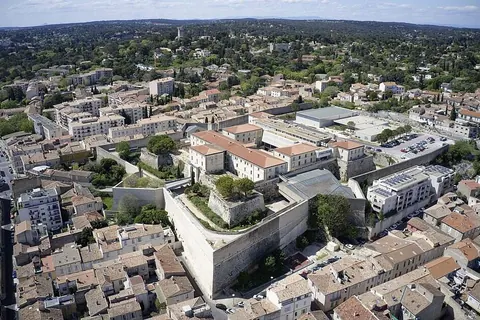

You are now standing in front of Fort Vauban. One detail is enough to understand why it was built: its cannons did not face outwards, but only towards the town. We are just after the revocation of the Edict of Nantes, in 1685. Louis the Fourteenth distrusts Languedoc, a largely Protestant region, and wants to be able to keep watch over Nîmes. The citadel rises at astonishing speed: from May 1687 to May 1688, around 2,000 workers, soldiers and townspeople work on it. The plan is a square flanked by four corner bastions, surrounded by a ditch 9 metres wide. After the Revolution, the fort begins a new life: a workhouse for beggars under Napoleon in 1811, then a central prison from 1819. The prison sees a major riot in 1974, with fires, and closes in 1991. The town buys the site, and the architect Andrea Bruno turns it into a campus. Students have been coming here since 11 October 1995. As you walk, notice how the contemporary additions rest on the walls of the citadel without erasing them.
History
The fort was built after the revocation of the Edict of Nantes in 1685. Louis XIV regarded Languedoc, which was mainly Protestant, as a possible hotbed of rebellion, and wanted a citadel capable of holding the town. The plans are attributed to Jacques Cubizol and Jean Papot, with the engineer François Ferry, a colleague of Vauban. Work was carried out between May 1687 and May 1688 with up to 2,000 workers, soldiers and townspeople.
The citadel kept its military role until 1792. In 1811, Napoleon turned it into a workhouse for beggars, to which a house of correction was added in 1813. In 1819, it became a central prison: it held around 275 inmates in 1820 and 1,142 people in 1830. During the Second World War, it held political prisoners opposed to Vichy and the Nazis.
Art and architecture
The fort follows a square plan with four corner bastions, surrounded by a ditch 9 metres wide. This layout, typical of the fortifications of the time, allowed crossfire along the walls. What makes Nîmes special is the direction of the artillery: the cannons were placed only on the flank facing the town, which clearly shows that the expected threat came from within and not from a foreign army.
Winner of the 1991 competition, the architect Andrea Bruno wanted to open the fort up to the town. He chose reversible contemporary additions that respect the historic features instead of hiding them. In his statement, he stresses the fort’s privileged location, within the urban fabric and close to the historic centre.
Anecdotes
The site’s history as a prison was long and sometimes violent. In 1974, a major riot broke out in the prison: fires destroyed part of the buildings. The central prison finally closed in 1991, just after the town bought the site in 1990. Four years later, on 11 October 1995, the university campus was inaugurated. The same place was thus in turn a citadel, a workhouse for beggars, a prison and a university.
What to look for
Start by walking around the outside to read the square plan and spot a bastion. Then observe the contrast between the stone of the citadel and Andrea Bruno’s contemporary interventions. Looking at the walls facing the centre, ask yourself where the artillery that kept watch over Nîmes might have stood.
Practical
The fort overlooks the north of the Écusson, near the Tour Magne district. It is a working university site: access to the inside depends on the opening hours and rules of the University of Nîmes, and the surroundings can be seen from the street.
Nearby
The castellum, where the Roman aqueduct arrived, is very close by. You can then walk up to the Jardins de la Fontaine and the Tour Magne. To learn more about the same architect, head to Rue de l’Aspic: Jacques Cubizol worked on several mansions there.
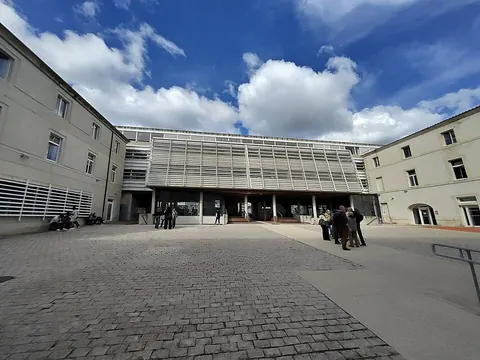

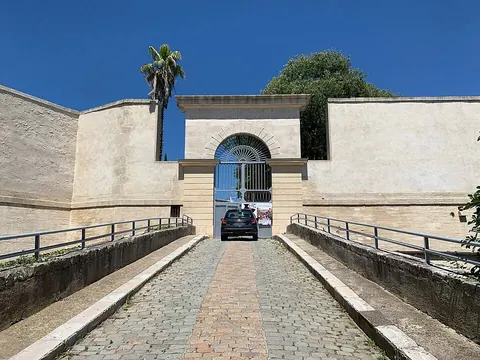

On site, look for: Spot a corner bastion, then look for where the contemporary architecture leans on the old walls.
Test yourself
Which way did the fort’s cannons face?
- Towards the Rhône
- Towards the sea
- Towards the town (answer)
How long did the main construction work last?
- About a year (answer)
- One month
- Ten years
What is in the fort today?
- A barracks
- A prison
- The university (answer)
Sources
Information checked on 6 October 2026.