
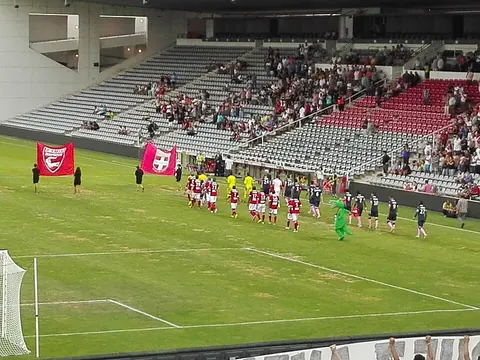
You are now in front of the Stade des Costières, in the south of Nîmes. On 15 February 1989, it was inaugurated with a match between the French B team and the Netherlands, featuring a certain Dennis Bergkamp. A few weeks later, on 4 March, Nîmes Olympique played its first match here, against Montceau, in the second division. For more than thirty years, from 1989 to 2022, the Crocodiles welcomed their opponents here. The stadium was designed by Marc Chausse and the Italian Vittorio Gregotti, who also designed the Luigi Ferraris stadium in Genoa. Its name comes from the Costières wine-growing plateau, which stretches south of Nîmes for nearly forty kilometres. Notice its special feature: four separate stands, not linked to each other, so you cannot walk all the way around the stadium through the terraces. The attendance record dates from 1996: 23,454 spectators for France against Greece, in preparation for the European Championship. Since 2022, Nîmes Olympique has played at the Stade des Antonins, and the Costières is waiting for its future.
History
The project was launched by the Bousquet municipal administration in January 1987, in the new Costières district built in the mid 1980s. The stands were built between 1987 and 1989. The stadium was inaugurated on 15 February 1989 with a match between the French B team and the Netherlands. It remained the home ground of Nîmes Olympique until 2022, when the club moved to the Stade des Antonins.
In 2024, the town refused the owner planning permission for a new stadium; studies have been commissioned to estimate the cost of a renovation.
Art and architecture
The stadium is the work of the architects Marc Chausse and Vittorio Gregotti. Four independent stands surround the pitch: the North stand, the main one, houses the presidential box, the hospitality boxes, the press, the changing rooms and the television studios; the South stand, also covered, has around 6,000 seats; the East and West terraces offer around 3,400 and 3,700 places.
Anecdotes
The attendance record was set in 1996 at a friendly between France and Greece (3 to 1) in front of 23,454 spectators. After the Furiani disaster, a commission estimated in July 1992 that the stadium could hold up to 29,497 people. The stadium has also hosted rugby: on 7 May 1989, Toulon against Béziers drew at least 26,000 spectators.
What to look for
From the surroundings, observe the clear separation between the four stands and the two roofs of the North and South stands. The pitch measures about 105 metres by 68. It has no undersoil heating: the Mediterranean climate does not require it.
Practical
The stadium is on the southern outskirts, near the exhibition centre, the Parnasse hall and the Nemausa aquatic centre. It is served by line T1 (Costières-Parnasse stop) and line 7 (Costières stop) of the Tango network; the bus rapid transit links it to the town centre in under 10 minutes. The stadium has not been used since 2022.
Nearby
Close by, Kishō Kurokawa’s Colisée, headquarters of Nîmes Métropole, echoes the Arena with its round shape. The Nîmes Olympique club, founded in 1937, now plays at the Stade des Antonins.
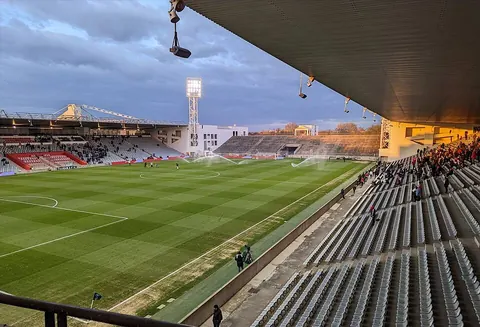


On site, look for: Count the stands visible from outside and spot the two that are covered.
Test yourself
In what year was the stadium inaugurated?
- 1937
- 1989 (answer)
- 2002
Which Italian architect designed it with Marc Chausse?
- Gae Aulenti
- Renzo Piano
- Vittorio Gregotti (answer)
Where does the name Costières come from?
- A general
- A river
- A wine-growing plateau (answer)
Sources
Information checked on 6 October 2026.