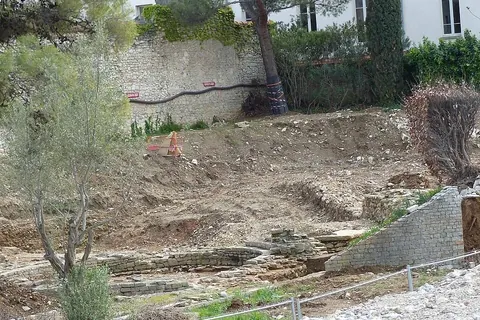

You are now on the line of the Roman walls of Nîmes. Picture a wall nearly 10 metres high and up to 3 metres thick, running for more than 6 kilometres. It was built under the emperor Augustus, at the end of the first century before the common era, around the colony of Nemausus. Yet this was a time of peace: the rampart was above all an imperial favour and a matter of prestige. In Roman Gaul, only Vienne had a longer circuit of walls. The wall enclosed 220 hectares and had around 80 towers and about ten gates. These walls still protected the town after the fall of Rome, until Charles Martel’s destruction in the eighth century. Today, no tower survives to its full height, except the Tour Magne, which has lost its crowning section. Two gates partly survive: the Porte d’Auguste and the Porte de France. Look at the base of the walls: several courses of large stones, then a facing of small rubble blocks.
History
The walls were built under Augustus, towards the end of the 1st century BC, for the colony of Nemausus, capital of the Arecomici. Built in peacetime, they reflect an imperial favour towards a colony under Latin law. They remained in good condition for several centuries, at first resisted the Franks, but suffered from Charles Martel’s destruction in the 8th century. In the 11th century, a much smaller medieval wall replaced them.
Art and architecture
The rampart measured a little over 6 kilometres and enclosed 220 hectares. The walls reached nearly 10 metres in height and up to 3 metres in thickness. The facing was made of pointed rubble blocks, with a rubble core inside; the base had several courses of medium and large masonry. The top was crowned with slabs about thirty centimetres thick, taken from the Barutel quarry.
Anecdotes
There were around 80 towers and about ten gates. The Porte de France, modest but fitted with a portcullis, did not serve the Via Domitia towards Hispania as was long believed, but a secondary road. At the Museum of Roman History (Musée de la Romanité), the internal street follows the line of the rampart, and the archaeological garden preserves foundations of the Augustan wall with a tower.
What to look for
The remains are scattered around the town. The most spectacular are the Tour Magne, at the top of Mont Cavalier, the Porte d’Auguste and the Porte de France. Notice the difference between the base of large blocks and the upper courses of small rubble.
Practical
The remains of the walls have been listed as historic monuments since 31 October 1989. Most can be seen freely from the street. For a complete picture, combine the Porte de France, the Porte d’Auguste, the garden of the Musée de la Romanité and the Tour Magne, accessible with a ticket.
Nearby
Then follow the trail to the Porte de France, very close to the centre, and on to the Porte d’Auguste, one of the two main entrances. The archaeological garden of the Musée de la Romanité shows foundations of the rampart in a landscaped setting.
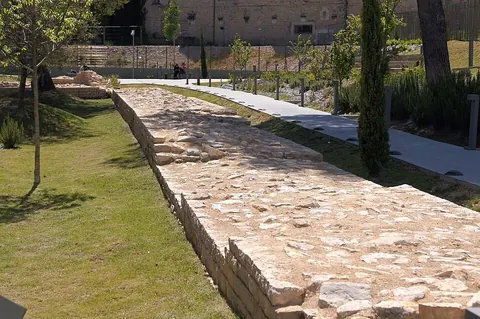

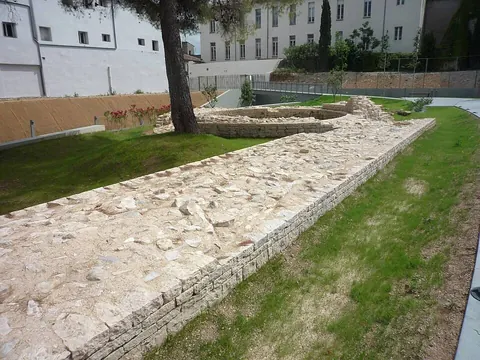

On site, look for: At the base of the wall, look for the large dressed stones beneath the small rubble masonry.
Test yourself
Under which emperor were the walls built?
- Augustus (answer)
- Hadrian
- Nero
How long were they?
- 1 km
- 15 km
- More than 6 km (answer)
Which tower still stands upright?
- The Eiffel Tower
- The Tour Magne (answer)
- The Tour de Constance
Sources
- Wikipedia: Roman walls of Nîmes
- Wikipedia: Porte de France (Nîmes)
- Objectif Gard: at the Musée de la Romanité, there is also the archaeological garden (2020)
Information checked on 6 October 2026.