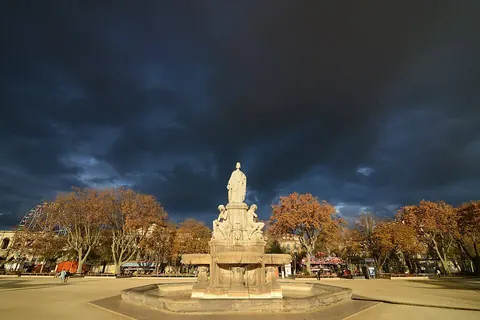

Here you are on avenue Feuchères, the grand avenue linking the station to the Esplanade Charles-de-Gaulle. In 1841, the Nîmes town council decided to lay out both this avenue and the esplanade, and the work was completed in 1851. The avenue thus gives travellers a stately entrance to the city: as you leave the station, you walk straight up towards the Pradier fountain and the Arena. Its name honours Adrien Victor Feuchères, general commanding the Nîmes subdivision and member of parliament for the Gard from 1846 to 1848. His story is an unusual one: married to Sophie Dawes, he discovered that she was the mistress of the Prince of Condé and separated from her. When she died in 1840, he refused her inheritance, which he called "the wages of vice", and gave it to local charities. Look at the ground: a small channel 1.4 metres wide starts from the esplanade and runs down the avenue to the front of the station, a feature created during the renovation of 2010 to 2012. Walk towards the esplanade, using the spire of the church of Sainte-Perpétue as your landmark.
History
The arrival of the railway transformed the south of Nîmes. The present station came into service in 1843, and as early as 1841 the town council decided to lay out avenue Feuchères and the esplanade. The work was completed in 1851, the year the Pradier fountain was inaugurated. From then on, the avenue formed the axis leading travellers from the station to the heart of the city.
It bears the name of Adrien Victor Feuchères (1785 to 1857), an officer who fought at Jena, Eylau and Friedland, became a brigadier general, commanded the Nîmes subdivision and sat as member of parliament for the Gard from 1846 to 1848.
Art and architecture
The avenue is designed as a vista: on one side the long façade of the station, about 100 metres, on the other the esplanade and the Pradier fountain. The renovation of the esplanade, carried out from 2010 to 2012 by the landscape architect Alain Marguerit, extended the garden as far as the avenue with a channel 1.4 metres wide that runs down to the front of the station.
Anecdotes
In London in 1818, Feuchères married Sophie Dawes, whom he believed to be the natural daughter of the Prince of Condé. She was in fact his mistress. He separated from her in 1824, causing a scandal. After Sophie’s death in 1840, he refused her fortune and gave it to the region’s charities.
A secondary school in Nîmes also bears his name.
What to look for
Stand in the middle of the avenue, with your back to the station: the view runs towards the esplanade and the spire of Sainte-Perpétue. Follow the small channel on the ground. Then turn around to see the station façade and its arches on two levels.
Practical
The avenue takes just a few minutes to walk from the station to the esplanade. It is the simplest route to the Arena and the Écusson when arriving by train. Free access.
Nearby
At the end of the avenue, the Esplanade Charles-de-Gaulle, the Pradier fountain and the church of Sainte-Perpétue. The Arena is just behind. In the other direction, the station, the starting point of the tours.
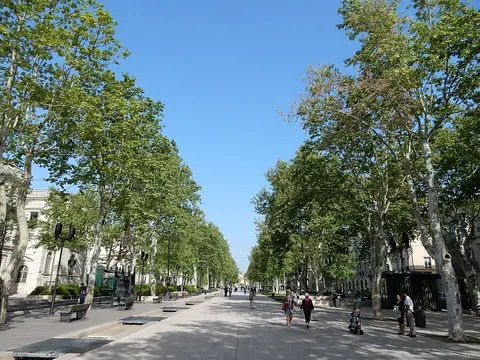

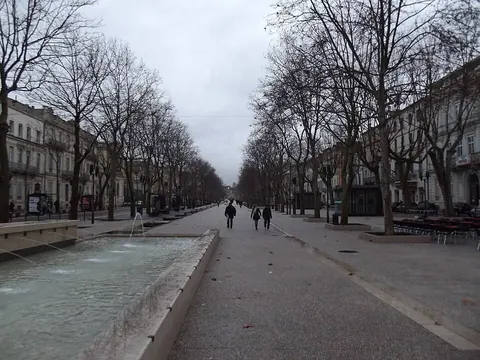

On site, look for: Follow the small channel from the station and find the spot where it meets the esplanade.
Test yourself
Which places does avenue Feuchères link?
- The Arena and the Tour Magne
- The Maison Carrée and the Jardins de la Fontaine
- The station and the esplanade (answer)
Who was Feuchères?
- A bishop
- A general (answer)
- An architect
In which year was the avenue’s layout decided?
- 1789
- 1841 (answer)
- 1920
Sources
- Wikipedia: Esplanade Charles-de-Gaulle (Nîmes)
- Wikipedia: Adrien Victor Feuchères
- Wikipedia: Gare de Nîmes-Centre
Information checked on 6 October 2026.