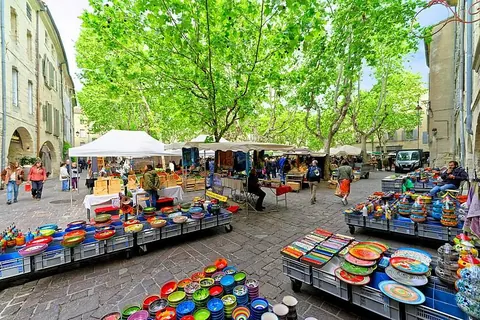

Here you are in Uzès, 25 kilometres from Nîmes, which you can reach by car or by liO network coach. You are on the Place aux Herbes, shaded by plane trees and surrounded by arcaded houses. On Saturdays, it hosts a very popular weekly market. Uzès presents itself as the first duchy of France: in 1565, King Charles IX raised the viscountcy to a duchy, and Antoine de Crussol became its first duke. The Crussol family still holds the title today. Then stroll over to the cathedral of Saint-Théodorit. Its bell tower, the Tour Fenestrelle, 42 metres high, is the only round bell tower in France, comparable to the Lombard campaniles of Italy. It lost two storeys during the Wars of Religion in the seventeenth century. If the cathedral is open, look at its seventeenth-century organ with decorated shutters, the only one of its kind in France still in its original state. Finally, remember that the water of Nîmes started from here: the Eure spring, near Uzès, fed the Roman aqueduct that crosses the Gardon at the Pont du Gard.
History
In May 1565, by letters patent issued at Mont-de-Marsan, Charles IX raised the viscountcy of Uzès to a duchy; it became a duchy-peerage in February 1572. Antoine de Crussol (1528 to 1573) was its first duke. The Crussol family took up the name and arms of Uzès, and since 2001 the title has been held by Jacques-Emmanuel de Crussol d’Uzès.
Uzès is designated a Town of Art and History and has a protected conservation area created in 1965. The town had 8,519 inhabitants in 2023.
Art and architecture
The cathedral of Saint-Théodorit was begun in 1090, rebuilt from 1642 to 1663, and its façade dates from 1873. It is mainly classical, with Romanesque remains. Its Tour Fenestrelle, 42 metres high and Romanesque in style, is the only round bell tower in France, comparable to the Lombard campaniles.
Inside, the seventeenth-century organ with decorated shutters is presented as the only one of its kind in France still in its original state. The tower was listed as a historic monument in 1862, the whole cathedral in 1963.
Anecdotes
The Tour Fenestrelle lost two storeys during the Wars of Religion, in the seventeenth century.
After the Concordat of 1801, the diocese of Uzès was abolished: the cathedral became a parish church, while keeping its name.
What to look for
On the Place aux Herbes, look at the arcades and the plane trees. At the cathedral, walk around the Tour Fenestrelle to appreciate its round shape and its windows. If the church is open, look up at the painted shutters of the organ.
Practical
Uzès is 25 kilometres from Nîmes. Without a car, the regional liO coach network links the two towns: check the route, timetable and journey time on the liO website. The tourist office is in the Chapelle des Capucins, Place Albert-Ier, telephone 04 66 22 68 88.
Come on a Saturday for the market on the Place aux Herbes, and arrive early.
Nearby
The Eure spring, near Uzès, is the starting point of the Roman aqueduct of Nîmes: the Pont du Gard, along its route, combines well with Uzès in a single day. Back in Nîmes, the castellum aquae shows where this water arrived in the city.


On site, look for: On the Tour Fenestrelle, count the storeys pierced with windows that remain today.
Test yourself
What title does Uzès claim?
- First Roman town in France
- First duchy of France (answer)
- Smallest cathedral in France
What is special about the Tour Fenestrelle?
- It is a round bell tower (answer)
- It is made of wood
- It leans
On which day is the big market on the Place aux Herbes held?
- Monday
- Saturday (answer)
- Thursday
Sources
- Wikipedia: Uzès
- Wikipedia: Cathédrale Saint-Théodorit d’Uzès
- Wikipedia: Duché d’Uzès
- Pays d’Uzès Pont du Gard tourist office
Information checked on 6 October 2026.