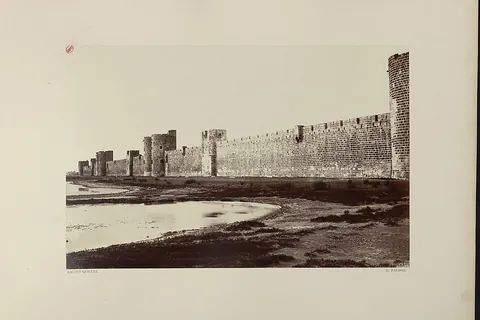

Here you are at the foot of the Tour de Constance, in Aigues-Mortes, a fortified town in the Camargue that you can reach from Nîmes by TER regional train, on the line towards Le Grau-du-Roi. Around 1240, King Louis IX, Saint Louis, acquired this site to gain access to the Mediterranean. He had a port built here, and it was from here that he set sail for the Seventh Crusade in 1248, then for the Eighth in 1270, towards Tunis. The Tour de Constance was built from 1242 to 1254: 22 metres in diameter, walls 6 metres thick at the base, and a lookout turret that served as a lighthouse from the thirteenth to the sixteenth century. The tower later became a prison. After the revocation of the Edict of Nantes, Protestant women were locked up here. The most famous, Marie Durand, entered at the age of 19 and only came out 38 years later. She is credited with the inscription "REGISTER", meaning resist, carved on the rim of the well and still visible. The ramparts around the town measure 1,640 metres, with 15 towers and 10 gates: walk around them, on foot or along the wall walk if the visit is open.
History
Around 1240, Louis IX acquired the site to open the kingdom to the Mediterranean, and around 1241 he had a port built, defended by a fortified town. He set sail from here for the Seventh Crusade in 1248 and for the Eighth in 1270, towards Tunis.
The Tour de Constance was built from 1242 to 1254. The town walls were completed under his successors: a contract was signed in 1272 with the Genoese Guglielmo Boccanegra under Philip III, and work resumed in 1289 under Philip the Fair. The tower and ramparts were listed as historic monuments on 1 December 1903.
Art and architecture
The Tour de Constance is 22 metres in diameter and 32 metres high up to the terrace, topped by a lookout turret about 11 metres high. Its walls are 6 metres thick at the base.
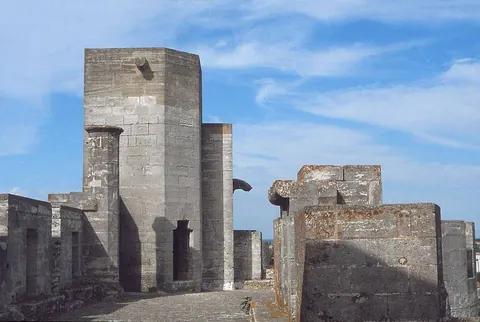
The rectangular town wall is 1,640 metres long and 11 metres high; it is flanked by 15 towers and pierced by 10 gates. It is an exceptional example of thirteenth and fourteenth-century military architecture in a marshland setting.
Anecdotes
Between 8 and 11 November 1307, 45 Templars were imprisoned in the tower. Later, it served as a prison for Protestant women. Marie Durand, locked up at 19, was only released 38 years later; the inscription REGISTER, on the rim of the well, is attributed to her.
The lookout turret served as a lighthouse from the thirteenth to the sixteenth century to guide ships.
What to look for
In the tower, look for the rim of the well and the inscription REGISTER. From the top, if you climb up, look at the town’s regular grid plan and, in the distance, the salt marshes. Along the ramparts, spot the gates and towers of the town wall.
Practical
From Nîmes-Centre station, TER Occitanie trains on the line towards Le Grau-du-Roi serve Aigues-Mortes station, at the foot of the fortified town. Check times and journey length on sncf-connect.com. The tower and ramparts are managed by the Centre des monuments nationaux: opening hours and prices are on their website.
Accessibility of the tower is shown as limited on OpenStreetMap.
Nearby
The Aigues-Mortes salt works operate in the Peccais marsh. The town lies in the Rhône delta, recognised as a UNESCO biosphere reserve in 1977. North of the town, the Tour Carbonnière served as a watchtower on the access road.
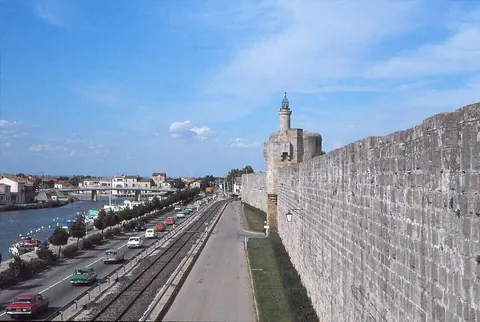


On site, look for: Walk around the town walls and count the gates: you should find 10.
Test yourself
Which king founded the port of Aigues-Mortes?
- Henri IV
- Louis IX (answer)
- Louis XIV
How many towers do the ramparts have?
- 15 (answer)
- 30
- 4
What does the inscription REGISTER mean?
- Hope
- Pray
- Resist (answer)
Sources
- Wikipedia: Aigues-Mortes
- Wikipedia: Tour de Constance
- Wikipedia: Remparts d’Aigues-Mortes
- Wikipedia: Gare d’Aigues-Mortes
- OpenStreetMap: Tour de Constance
Information checked on 6 October 2026.