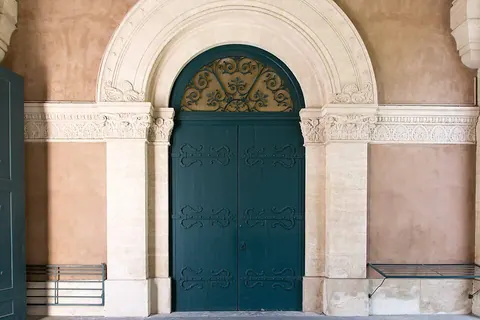

You are now at the entrance to the Protestant cemetery, at 17 bis Avenue du Pasteur-Paul-Brunel, the old road to Alès. Go back in time: until the end of the eighteenth century, the Protestants of Nîmes were not allowed to be buried in the cemeteries. In 1776, Louis the Sixteenth authorised it, and the first burial took place here in 1782, in plots of vines and olive trees, outside the town. The site thus became the oldest communal Protestant cemetery in France. It has nearly 6,000 graves. Among them are names you may know: the poet Francis Ponge, the economist Charles Gide, the architect Henri-Jacques Espérandieu, the bull breeder Fanfonne Guillierme, and Louis Rossel, the only senior officer to join the Paris Commune, shot in 1871 and buried here at night. Look out too for the statue of Immortality, two metres high, the last sculpture by James Pradier, listed as a historic monument since 1911. Walk slowly, and respect the peace of the place.
History
Under the Ancien Régime, burials of members of the Reformed Church were forbidden in the cemeteries of Nîmes. King Louis XVI granted permission in 1776, and the first burial took place in 1782, in plots of vines and olive trees outside the town. The cemetery has been listed as a historic monument since 2001.
Art and architecture
The cemetery contains the funerary statue of Immortality, two metres high, the last sculpture by James Pradier, who made the fountain on the esplanade. It has been listed as a historic object since 20 December 1911. Pradier came from a Protestant family that had fled Languedoc after the revocation of the Edict of Nantes.
Anecdotes
Louis-Nathaniel Rossel, an officer from a Protestant family in Nîmes, joined the Paris Commune in 1871. Despite a petition signed by, among others, Victor Hugo asking for his pardon, he was executed. He was buried discreetly and at night in the Protestant cemetery of Nîmes, alongside his sister and his parents.
What to look for
Among the notable people buried here: the poet Francis Ponge, the economist Charles Gide, the architect Henri-Jacques Espérandieu, the astronomer Benjamin Valz, the painter Jules Salles-Wagner, the novelist Élisabeth Barbier, the bull breeder Fanfonne Guillierme, the caver Robert de Joly, the aviator and painter Jacques Favre de Thierrens and the architect Jean Dubuisson. Take time to read the epitaphs.
Practical
The cemetery is at 17 bis Avenue du Pasteur-Paul-Brunel, north-west of the centre. A bus stop called Cimetière Protestant is on the avenue. It is a place of remembrance still in use, with around 2,720 graves still active: please be discreet.
Nearby
To continue with the Protestant history of Nîmes, visit the Grand Temple, on Boulevard Amiral-Courbet. You will find Pradier again on the Esplanade Charles-de-Gaulle, with his allegorical fountain of the town. The Jardins de la Fontaine and the Tour Magne are also in this north-western quarter of the town.
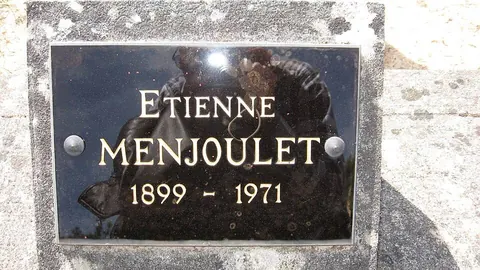

On site, look for: Find the statue of Immortality, James Pradier’s last work.
Test yourself
Who authorised this cemetery in 1776?
- Henri IV
- Louis XVI (answer)
- Napoleon
Roughly how many graves does it have?
- 6,000 (answer)
- 60,000
- 600
Which sculptor made the statue of Immortality?
- Auguste Rodin
- Bartholdi
- James Pradier (answer)
Sources
- Wikipedia: Protestant Cemetery of Nîmes
- Wikipedia: Louis Rossel
- Wikipedia: James Pradier
- Wikipedia: Francis Ponge
- Commons: Protestant cemetery, Nîmes (Mérimée PA30000037)
Information checked on 6 October 2026.