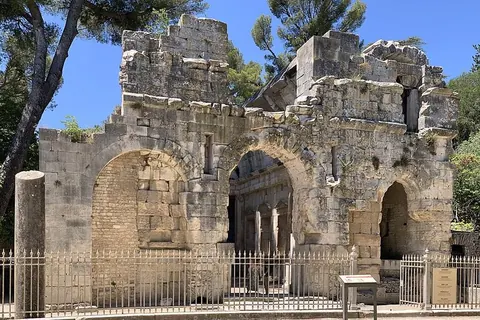

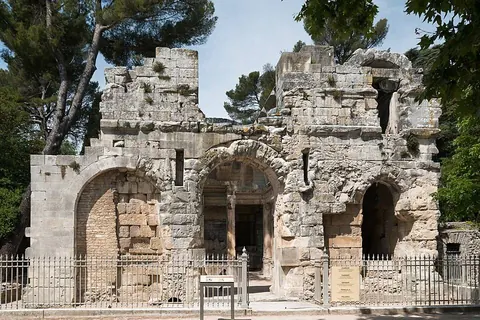
Here you are in front of the Temple of Diana, in the Jardins de la Fontaine. Despite its name, nothing proves that this building was dedicated to Diana: the name has no known archaeological or historical basis. Built in the first century AD, it was part of a sanctuary dedicated to Augustus. Its plan, close to that of a basilica, does not match that of a classical Roman temple, and its real purpose is still debated. The vaulted hall is 14.52 metres long and 9.55 metres wide. The main façade opened through three arches. In the Middle Ages, the building was turned into a monastery, which allowed it to survive. In the eighteenth century, its ruins inspired painters such as Hubert Robert. Step inside and look at the inner walls: five rectangular niches are topped by pediments that are alternately triangular and rounded, framed by columns of the Composite order. In the compartments at the back, look for the remains of carved coffered ceilings. The monument belongs to the city and has been a listed historic monument since 1840.
History
The building dates from the first century AD and belonged to a sanctuary dedicated to Augustus, the Augusteum, set around the spring. In the Middle Ages, it was converted into a monastery, and this occupation helped to preserve it. In the eighteenth century, its ruins fascinated artists, including Hubert Robert. It was listed as a historic monument in 1840, protected again in 1989, and belongs to the city of Nîmes.
Art and architecture
The vaulted hall measures 14.52 metres by 9.55. The main façade had three arched openings. Its basilica-like plan, unusual for a Roman temple, explains the doubts about its purpose.
The inner walls feature five rectangular niches, crowned by pediments that are alternately triangular and semicircular, and supported by columns of the Composite order. The compartments at the back retain decorated coffered ceilings.
Anecdotes
The name Diana is a tradition with no known archaeological or historical support. The actual use of the hall remains uncertain: its exact purpose is still debated, which makes it one of the mysteries of ancient Nîmes.
What to look for
Look at the vault and imagine it complete. Spot the alternating pediments above the niches and the Composite columns. At the back, look up at the remains of the carved coffers. From outside, look for traces of the three arches of the façade.
Practical
The temple stands in the Jardins de la Fontaine, freely accessible during the gardens’ opening hours, which you can check on nimes.fr. You can walk there from the Quais de la Fontaine. The ground around the ruins is uneven.
Nearby
The pools of the Jardins de la Fontaine and the spring are just a few steps away. By climbing Mont Cavalier, you will reach the Tour Magne. The Museum of Roman History (Musée de la Romanité) displays other elements of ancient Nîmes.

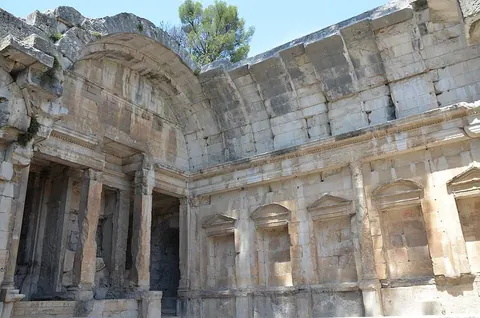

On site, look for: Count the niches and check that their pediments really do alternate between triangle and arc.
Test yourself
Is the name "of Diana" proven?
- No (answer)
- Yes, by a statue
- Yes, by an inscription
What was the building turned into in the Middle Ages?
- A mill
- A monastery (answer)
- A prison
Which painter was inspired by it in the eighteenth century?
- Claude Monet
- Hubert Robert (answer)
- Paul Cézanne
Sources
Information checked on 6 October 2026.