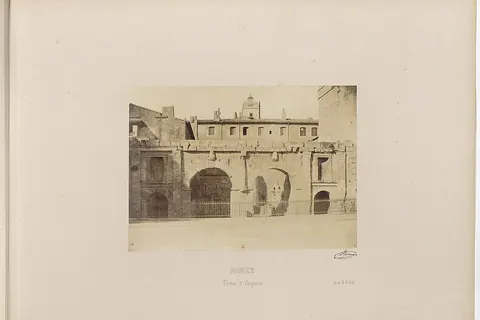

Here you are in front of the Porte d’Auguste, the Gate of Augustus, built around 16 BC during the reign of Augustus. It was once called the Arles Gate. It was one of the main entrances to the Roman colony of Nemausus: the Via Domitia, which linked Italy to Spain, entered the town here. The gate was part of the great Roman wall, of which the Tour Magne is another remnant. Look at its four round-arched vaulted passages: the two large ones in the centre were reserved for vehicles, and the two small ones on the sides for pedestrians. Two semicircular towers protected it; their position is now marked on the ground by circles of flat stones. Look up at the upper frieze: the inscription is still legible. It lists the titles of the emperor Augustus and recalls his tribunician power, at the time of his eleventh consulship. The gate stands east of the Écusson and has been a listed historic monument since 1840.
History
The gate was built around 16 BC, under Augustus. Formerly called the Arles Gate, it marked the arrival of the Via Domitia in the colony of Nemausus and formed part of the town’s vast defensive wall. It was listed as a historic monument in 1840.
Art and architecture
Built of stone, it has four round-arched passages: two large ones in the centre for vehicles, two small ones on the sides for pedestrians. Two semicircular towers flanked it. On the upper frieze, a still legible inscription details the imperial titles of Augustus and his tribunician power, during his eleventh consulship.
Anecdotes
The towers have gone, but their outline is not lost: circles of flat stones in the paving show where they stood. The gate is a reminder that Nîmes was a stop on the great Roman road between Italy and Spain.
What to look for
Compare the size of the central and side passages. Look for the stone circles on the ground. Finally, look up at the frieze to read the inscription in Latin letters.
Practical
The gate is on rue Nationale, east of the Écusson. It is a public space with free access, visible at any time.
Nearby
To follow the Roman wall, then climb up to the Tour Magne, its most imposing remnant. In the Écusson, the Maison Carrée and the Arena complete the ancient trail.
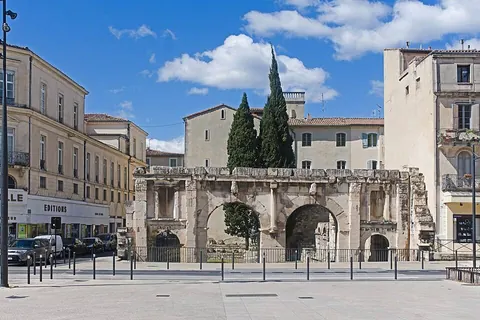

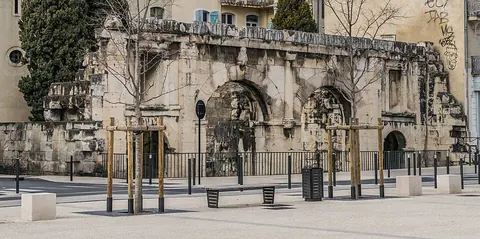

On site, look for: Spot on the ground the circles of stone that mark where the old towers stood.
Test yourself
How many passages does the gate have?
- 2
- 4 (answer)
- 6
Which Roman road entered through this gate?
- The Via Appia
- The Via Aurelia
- The Via Domitia (answer)
What was its former name?
- The Arles Gate (answer)
- The Rome Gate
- The Uzès Gate
Sources
Information checked on 6 October 2026.