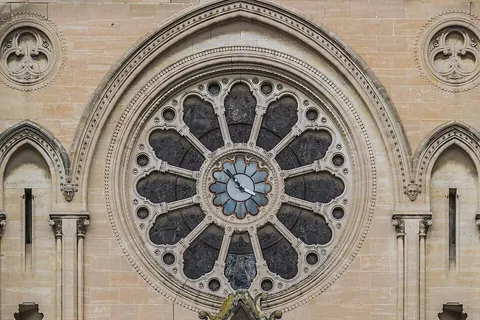

You are in front of the church of Saint-Baudile, on the place Gabriel-Péri. You can’t miss it: its façade carries two bell towers topped with spires that rise to 70 metres. The church was built between 1867 and 1877 by an architect from Bordeaux, Jean-Jules Mondet, in the neo-Gothic style. It is often compared with the church of the Sacré-Cœur in Bordeaux, designed by the same architect. It is dedicated to Saint Baudile, a Nîmes martyr of the third century. It is the largest church in Nîmes: 65 metres long, 30 metres wide at the transept, and 20 metres high under the vaults. It can hold about 3,000 people. As you go in, follow the nave up to the choir. Look at the stained glass by Joseph Villiet, the statues of angels carved by Léopold Morice, and the statue of Saint Baudile made by Auguste Bosc. Finally, listen out if the organ is playing: it bears the Cavaillé-Coll family name, and a symphonic-style instrument was built here in 1876 by Vincent Cavaillé-Coll.
History
The church of Saint-Baudile was built between 1867 and 1877 to the plans of Jean-Jules Mondet, an architect from Bordeaux. It is dedicated to Saint Baudile, martyred in Nîmes in the third century. With a capacity of about 3,000 worshippers, it is the largest church in Nîmes. Its style links it to the church of the Sacré-Cœur in Bordeaux, designed by the same architect, which makes Saint-Baudile an example of the neo-Gothic of the second half of the nineteenth century.
Art and architecture
The façade is dominated by two bell towers crowned with tall spires reaching 70 metres. The building is 65 metres long, 30 metres wide at the transept, and rises to 20 metres under the vaults. The interior decoration brings together stained glass by Joseph Villiet, statues of angels by Léopold Morice and a statue of Saint Baudile by Auguste Bosc. The symphonic-style organ was built in 1876 by Vincent Cavaillé-Coll.
Anecdotes
Saint-Baudile and Saint-Paul illustrate two nineteenth-century choices in Nîmes: neo-Romanesque for Saint-Paul, completed in 1849, and neo-Gothic for Saint-Baudile, begun eighteen years later. Another link: both churches have a Cavaillé-Coll organ, the one in Saint-Paul built in 1848 by Aristide, the one in Saint-Baudile in 1876 by Vincent.
What to look for
Start on the square to take in the façade and its two spires. Inside, walk up the nave and feel the 20 metres under the vaults, then stop at the crossing of the transept, 30 metres wide. Look for the statue of Saint Baudile by Auguste Bosc and the angels by Léopold Morice, then at the stained glass by Joseph Villiet. Finally, spot the organ case.
Practical
The church is on the place Gabriel-Péri, on the edge of the Écusson, a few minutes’ walk from the Jesuit Chapel and the Natural History Museum. It is an active place of worship: opening times vary, so ask the parish and be discreet during services. The façade can be seen from the square at any time.
Nearby
The Natural History Museum and the Jesuit Chapel, in the former college, are close by. To compare with another great nineteenth-century religious building project, head to the neo-Romanesque church of Saint-Paul, with its 62-metre bell tower and its paintings by Hippolyte Flandrin. The Planetarium, on Mont Duplan, rounds off an outing in this district.
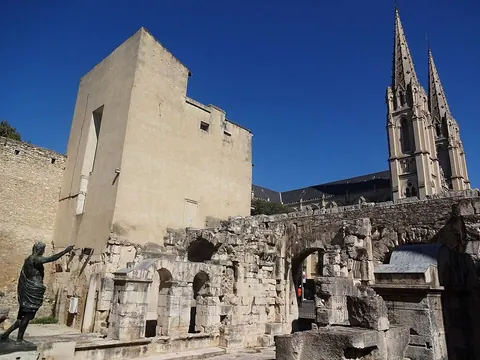


On site, look for: From the square, estimate how many times your height would fit into the 70 metres of the spires.
Test yourself
How tall are the spires?
- 150 metres
- 30 metres
- 70 metres (answer)
Who was Saint Baudile?
- A 19th-century bishop
- A 3rd-century Nîmes martyr (answer)
- A Roman emperor
In which style is the church built?
- Baroque
- Neo-Gothic (answer)
- Romanesque
Sources
Information checked on 6 October 2026.